
Property vendor insurance certificate tracking is a controlled process for identifying which contractors need current insurance evidence, checking whether that evidence meets the property’s requirements, and following up before a renewal or job assignment becomes urgent. A good schedule names the vendor, the policy or certificate expiry, the reviewer, the next work order, and what happens if the evidence remains unresolved. It never treats a verbal promise to send a certificate as proof of coverage.
Why insurance follow-up becomes a maintenance bottleneck
A facilities coordinator may have dozens of trades scheduled across several buildings: HVAC contractors, electricians, cleaners, roofers and emergency restoration crews. Each has a different renewal date, contract and type of work. The problem usually appears at dispatch, when a technician is ready to attend but the office cannot locate current paperwork. A hurried call asking, ‘Are you insured?’ creates no reliable audit trail and does not establish which contractual conditions are met.
The practical solution is to treat insurance evidence as an owned vendor-onboarding workstream, not as a loose PDF attachment. A maintenance board can show that an insurance review is pending without granting job access. The contractor’s service schedule and the risk or procurement team’s approval should remain distinct: a contractor can be available tomorrow but still not be cleared under the property’s policy.
What a certificate of insurance can and cannot establish
A certificate of insurance (COI) generally summarises policies, limits, insurers and policy dates. It is not itself an insurance contract. The Oregon Division of Financial Regulation explains that certificates are informational and do not amend, extend or change coverage. The Texas Department of Insurance similarly distinguishes certificate wording from endorsements and the policy itself.
For that reason, the office should not rely on a certificate’s headline limit alone. Have a qualified insurance or risk reviewer compare it with the signed vendor agreement and request endorsements or other policy evidence when required. Note the actual decision, the reviewer and the document version. A telephone check-in can ask whether the broker has supplied an update; it cannot certify coverage or create additional-insured status.
Create an evidence-first vendor register
Set up one vendor record with the legal business name, trade, approved contact, contracted sites, insurance-review owner, broker contact, policy categories, relevant renewal dates and a secure evidence link. Add a separate job-access status so that ‘documents received’ is not confused with ‘approved for assignment’. Avoid placing full policy files or sensitive contact details into an unrestricted project comment.
A sensible example status model is: requested → received → under review → clarification required → approved until date → expired or restricted. These are recommended administrative categories, not default Autoza or monday.com values. If a vendor serves several buildings, link every work order back to the same reviewed vendor record rather than duplicating conflicting expiry dates across boards.
A 45–30–14–7-day follow-up timetable
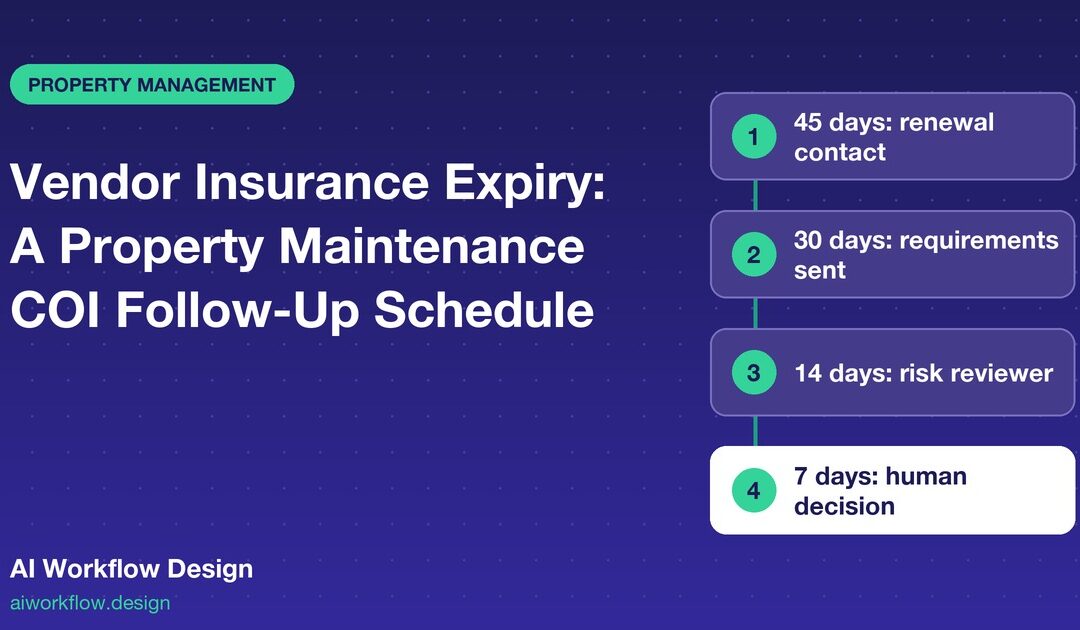
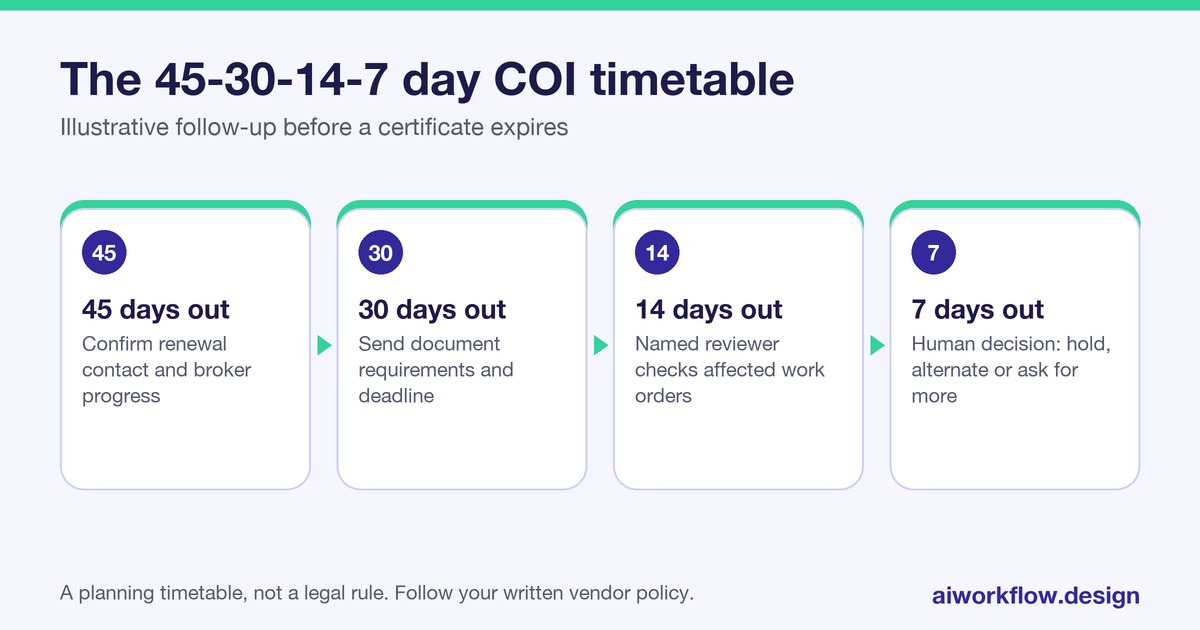
At 45 days before expiry, the vendor coordinator confirms the intended renewal contact and asks whether the broker has started the renewal. At 30 days, the office sends the document requirements and review deadline. At 14 days, outstanding evidence moves to a named risk reviewer and the scheduling team checks which future work orders might be affected. At seven days, unresolved cases receive a direct human review; the organisation decides whether to hold new assignments, use a qualified alternative or request further information.
This is an illustrative planning timetable, not a legal rule or a guarantee that an insurer must issue renewal evidence on those dates. Emergency situations need a separate risk and safety procedure. The follow-up cadence should also respect local calling permissions, the recipient’s availability and the organisation’s written vendor policy.
Questions to ask during a short vendor status call
For routine renewals, ask: ‘Have you requested the updated certificate from your broker?’ ‘When does the broker expect to deliver it?’ ‘Was any change to policy type, insurer or coverage reported?’ ‘Who can provide the required endorsement if one is requested?’ and ‘What is the best contact for the next update?’ Record the response verbatim or as a clear summary with its date. An uncertain answer must remain uncertain, not automatically become ‘approved’.
Where a vendor reports a lapse, cancellation, excluded activity or significant coverage change, end the automated administrative path and alert the authorised reviewer. Do not request bank data, unnecessary personal identifiers or policy documents through a general voice call. Direct evidence uploads to the organisation’s approved document system.
Map the workflow to monday.com and scheduled check-ins
Teams already using monday.com can keep a vendor-compliance board separate from the maintenance work-order board, linking records through vendor IDs and preserving permissions. AI Workflow Design describes Autoza AI for monday.com as supporting scheduled status calls, summaries and updates to boards. A proposed application is to collect a renewal ETA or flag an unanswered request. Whether a specific configuration supports the required field rules must be confirmed before rollout.
The AI-generated update should land in a ‘vendor-reported progress’ field. Only the risk or property-management approver changes the ‘insurance cleared’ and ‘approved for site’ fields. For related operational guidance, see the site’s property-repair and vendor coordination article and its wider blog resources.
Practical dashboard: make exceptions visible
A useful weekly view groups vendors into: current and approved; renewal due within 30 days; missing certificate; endorsement or coverage clarification; and access restricted. Show the next scheduled job, not just the earliest policy expiry. A vendor due to attend a vacant unit tomorrow is a more urgent operational decision than an inactive supplier whose renewal is two weeks away, even though both need attention.
Measure the percentage of active vendors with current reviewed evidence, unresolved items within the next seven days, average time from submission to review, and the number of dispatches paused for documentation. These are process metrics; they do not measure claims coverage or establish legal compliance. Periodically reconcile the vendor register against purchasing, access credentials and maintenance assignments.
Closing the loop without inventing clearance
Before approving a job assignment, ensure the right reviewer has assessed the actual evidence and recorded any conditions, exceptions or time limit. Preserve the source files and approvals in a secure repository with an appropriate retention policy. A broker may need to clarify an endorsement; a property manager may need to select another vendor; a site supervisor may need to update the schedule. Each decision deserves its own named owner.
A reliable COI process is not the one that sends the most reminders. It is the one that prevents a missing or misunderstood document from being mistaken for authorised site access. The next step is to map your vendor renewal stages and the status questions you can safely collect by phone.
Next step
Want fewer last-minute vendor status calls? Explore Autoza AI for monday.com and plan a human-approved renewal follow-up workflow.
Frequently asked questions
How often should property managers check vendor COIs?
Review at onboarding, ahead of each relevant renewal, and whenever a new job or contract change requires different coverage. A 45–30–14–7-day reminder schedule is a useful starting example, but the property’s contract and risk policy control the actual timetable.
Does an active certificate guarantee a contractor has the required coverage?
No. A COI is a summary and does not itself amend the policy. An authorised insurance reviewer may need to examine endorsements, exclusions, dates or other evidence against the vendor agreement.
Can an AI call approve a vendor for site access?
No. A scheduled call can request an ETA or capture that documents were submitted. The property’s designated reviewer must assess the evidence and apply the access decision.
What happens if a renewal remains outstanding before a work order?
Flag the affected work order and route it to the authorised risk and scheduling owners. Follow the written restriction, exception or alternative-vendor process; do not silently override it.
Where should insurance documents be stored?
Use an approved, access-controlled document repository linked from the vendor record. Keep sensitive files and policy details out of broadly shared call summaries or public board updates.
Related reading
- Storm Recovery Work Orders: A Property Vendor Update Checklist
- Mapping Vendor Call Answers to monday.com Maintenance Status Fields
- Preventive Maintenance Visits: A Vendor Confirmation Workflow for Property Managers
- Seasonal Property Maintenance: Plan Vendor Check-Ins Before Weather Changes
- Water Intrusion Repairs: Track Drying Evidence Without Declaring a Property Safe