
Quick answer: A lead safe renovation property manager checklist should establish whether a US building and proposed work fall within the EPA Renovation, Repair and Painting (RRP) framework or an applicable state programme, confirm the contractor’s required certification and trained personnel, track pre-renovation notices, record containment and work-practice responsibilities, and retain appropriate closeout evidence. An administrative check-in can follow missing paperwork; it cannot test for lead, certify that a work area is safe or waive regulatory obligations.
A maintenance request sounds ordinary: replace a window, repaint a hallway or repair a damaged wall in an older rental property. Yet when work disturbs painted surfaces in certain pre-1978 housing or child-occupied facilities, lead-safe renovation requirements may apply. The job should not move from estimate to dispatch on the strength of a contractor’s casual “we’ve done this before.” The property manager needs a documented intake and a qualified professional’s scope review.
This article focuses on the United States, where the EPA’s Renovation, Repair and Painting programme sets a federal framework, while authorised states and local rules may differ or add requirements. It is an administrative workflow guide, not legal advice, occupational-health advice or a substitute for certified renovator training.
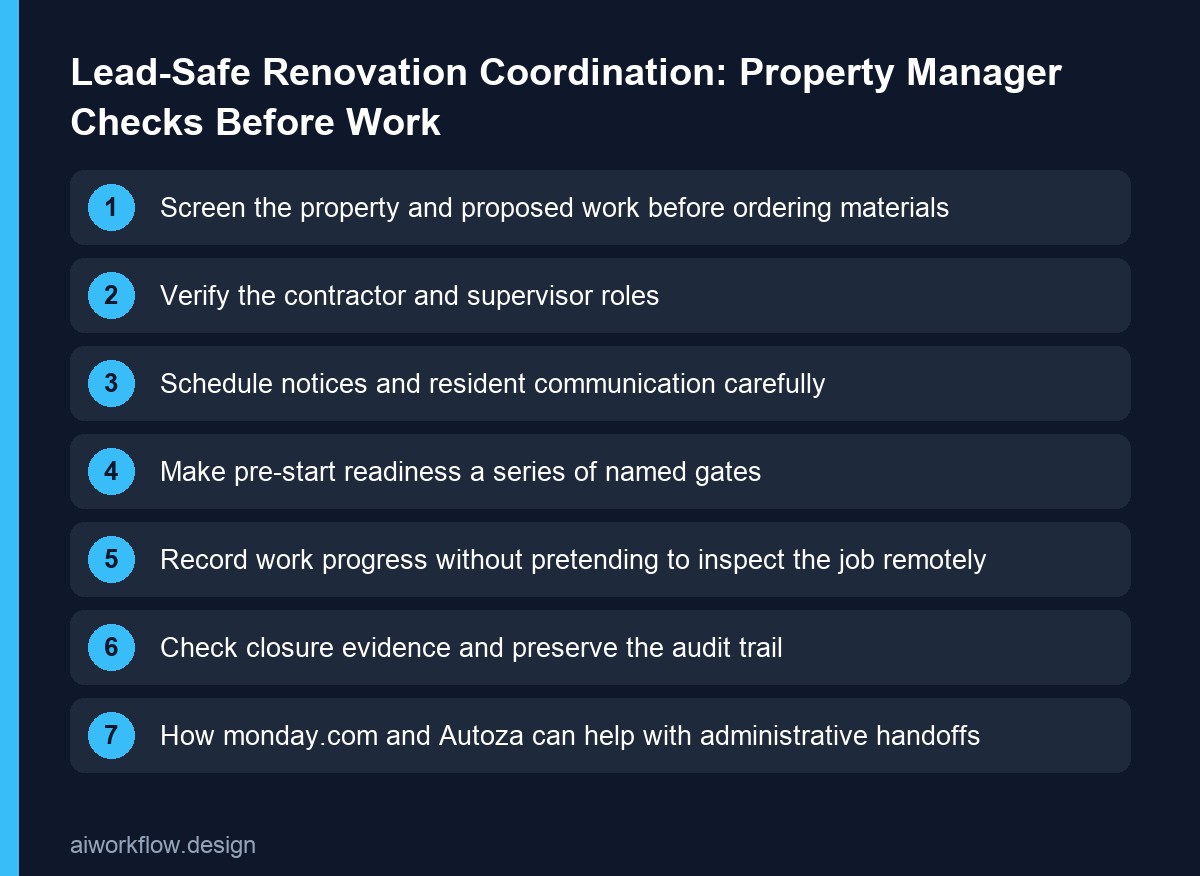
Screen the property and proposed work before ordering materials
Start with the building’s construction age, building type, occupancy, work description, location, potential disturbance of painted surfaces and any existing verified lead-testing records. A vague task such as “repair living room” will not tell a contractor whether the work involves sanding, demolition, window replacement or another activity that may fall within the rule.
Document the relevant unit, room or exterior area and anticipated methods without treating preliminary guesses as a professional hazard assessment. If the property has evidence that particular affected components have been declared lead-free through an authorised method, link that evidence for the qualified reviewer. Do not use a tenant’s recollection or an unqualified paint-store test as a regulatory determination.
The EPA lists exemptions and special situations, including particular housing types and certain minor repair work, but details matter. Window replacement and demolition, for example, are not automatically covered by a minor-repair exemption just because a small area is disturbed. Have the responsible certified professional review applicability and the current local programme before making a start decision.
Verify the contractor and supervisor roles
The EPA explains that firms doing covered compensated renovation work generally need Lead-Safe Certified Firm status, and that covered work must involve a certified renovator as required by the programme. Property managers who themselves offer or perform covered work may have certification obligations; hiring an outside certified firm changes the allocation of responsibilities but does not remove the need to choose an appropriately qualified contractor.
Track the firm’s legal name, credential reference, issuing authority, verification date, job scope, responsible certified renovator, relevant training arrangements and subcontractor roles. A generic insurance certificate or ordinary business licence is not proof of RRP qualification. Check current certification through the appropriate EPA or authorised state channel, rather than accepting a screenshot without verification.
The EPA’s property-manager guidance explicitly distinguishes a property manager performing covered work from one that hires a Lead-Safe Certified firm. Record which party is contractually responsible for occupant communication, site containment, cleaning verification and required records. These responsibilities should be settled before a crew arrives.
Schedule notices and resident communication carefully
Pre-renovation education and notice obligations depend on the work and applicable programme. The property’s reviewer should determine the correct recipients, timing, approved materials and evidence of delivery. Where the EPA’s *Renovate Right* information must be supplied, a dated administrative record helps prevent it becoming an afterthought. Do not substitute a generic marketing email for a prescribed delivery method without checking requirements.
Resident communication should address practical effects: location and dates, restricted access, who to contact, and how work will be separated from occupied areas. Avoid assuring residents that there is “no lead risk” merely because a contractor has a credential. Risk communication and accommodation requests belong with the property manager and qualified safety advisers.
Handle personal details carefully. A broad maintenance board may need an apartment identifier and notice status, but it does not need occupants’ medical histories or children’s personal information. Give authorised staff access to sensitive correspondence through an approved resident-management system.
Make pre-start readiness a series of named gates
An example workflow includes scope review by the contractor, applicability review by a qualified owner, credential confirmation, notice delivery, work-area planning, tenant access coordination, and authorised start approval under the property’s procedures. For each gate, capture an owner, dated evidence and the conditions that could require re-review.
Confirm that required supplies and containment resources are available before mobilising. The EPA’s guidance covers practices intended to limit hazardous dust, including containment and cleaning verification. The exact methods must be chosen and implemented by appropriately trained personnel according to the rule and actual site conditions. An administrative coordinator must not prescribe technical procedures from a checklist alone.
If the work changes from a minor repair to substantial demolition, or hidden damage increases the affected area, stop and have the qualified party reassess the job scope and requirements. Do not assume the original work order authorises every expanded activity.
Record work progress without pretending to inspect the job remotely
During work, the operations board can show mobilisation status, access issues, contractor progress, notice questions and the expected completion date. It should not display a blanket “safe” label based on an unverified phone summary. The certified renovator and other responsible professionals carry out the technical controls and required verification.
A suitable status question is: “Has the assigned contractor uploaded the required pre-renovation education record for Unit 4?” Another is: “Has the certified renovator confirmed the revised completion date to the property supervisor?” If the response mentions breached containment, uncontrolled dust or an unexpected hazard, the agent must direct that information to the responsible person promptly; routine scripts should not make a technical risk judgment.
Create a separate exception workflow for tenant complaints, changes in work area, access failures, damaged barriers or missing documentation. Record what was reported, to whom and when, while leaving the actual response to trained site personnel. A delayed document is not interchangeable with an unsafe condition.
Check closure evidence and preserve the audit trail
After the work, request the records required by the applicable programme and contract, which may include the certified firm’s details, work-practice documentation, cleaning verification and records relating to any lead testing or special determinations. Verify document completeness with the responsible expert. Do not claim that routine cleaning verification is the same as a comprehensive environmental clearance or health test.
Keep versioned work orders, scope changes, notices and incident communications linked to the relevant job. Apply the legally required retention period and any longer valid organisational requirement; do not choose a universal retention date without checking the programme. The next property manager should be able to understand what work occurred and locate the authorised supporting records.
For an older portfolio, review recurring maintenance types that may disturb paint. Better intake questions and verified vendor records reduce repeated uncertainty without requiring the board to store sensitive technical findings openly.
How monday.com and Autoza can help with administrative handoffs
Create an item for each renovation job with fields for construction-era review, scope, contractor, credential-check owner, notices, planned work dates, open dependencies, report links and review states. The record should distinguish “paperwork received” from “authorised to proceed.” Reminders can flag missing submissions using monday.com automations, while credential verification and regulatory decisions remain manual and documented.
If the team already uses Autoza AI for monday.com, a controlled, consented pilot can follow up on submitted documents and scheduling. The product offers scheduled status calls and board updates; it is not marketed as a lead-inspection or regulatory-clearance tool. For a complementary property workflow, see vendor insurance certificate follow-up, which similarly separates evidence collection from professional review.
Build a pause rule: a reported change in scope, possible exposure or disagreement about required precautions sends the job back to its authorised manager and certified contractor. Repeated AI calls are not an acceptable way to pressure a crew into starting before needed controls are satisfied.
Next step: improve the intake for one recurring repair type
Choose a common pre-1978 maintenance task and map its evidence, responsible reviewers and resident notices before dispatch. Explore AI Workflow Design’s administrative check-in tools if routine follow-ups need support, while keeping lead-safe decisions and field verification with the professionals responsible for them.
Frequently asked questions
Does the EPA RRP rule apply to all renovations in old buildings?
No. Applicability depends on the building and occupancy type, construction age, work performed, affected surfaces, exemptions and jurisdiction. Review the current EPA or authorised state rules and obtain a qualified determination for the actual job.
Does a property manager need RRP certification when hiring an outside contractor?
The EPA distinguishes property managers doing covered renovation work themselves from those hiring a certified outside firm. The outside firm must meet applicable obligations, but the property manager still needs to verify an appropriate contractor and manage the property’s contractual and administrative responsibilities.
What documents should be checked before renovation starts?
A clear scope, applicable rule review, verified contractor qualifications, responsible certified renovator, required notices or education records, site access arrangements and the authorised pre-start decision. Add job-specific requirements determined by the qualified reviewer.
Can an AI status call confirm that lead dust is no longer a risk?
No. A call may collect the status of a document or appointment. Testing, containment assessment, required cleaning verification and technical health or environmental determinations must remain with qualified people using accepted procedures.
What if the scope changes after the crew begins?
Pause the affected work as required by the safety plan, reassess the new scope and applicable controls with the certified contractor, update notices or permissions if needed, and document the authorised decision before continuing.
Related reading
- Fire Safety Inspection Records: A Property Manager Follow-Up Plan
- Water Intrusion Repairs: Track Drying Evidence Without Declaring a Property Safe
- Vendor Insurance Expiry: A Property Maintenance COI Follow-Up Schedule
- Preventive Maintenance Visits: A Vendor Confirmation Workflow for Property Managers
- Tenant Fit-Out Projects: Coordinating Landlord, Tenant and Contractor Actions
- More AI workflow guides