

Quick answer: A field service job sign-off dispute workflow separates four states: what the technician reports as completed, what the customer acknowledges, which issues remain disputed and what the authorised business owner has formally closed. Collect service evidence and the customer’s specific concern before changing any state. A missed signature or unanswered call is never automatic acceptance, and an AI agent should not decide whether work, payment or a warranty claim has been resolved.
A technician fixes a failing pump, checks pressure and marks a job complete. The customer, however, says the pump is still noisy and refuses to sign. If the dispatch system immediately sends an invoice and closes the ticket, everyone is left arguing from different versions of the event: the technician’s completed task, the customer’s unresolved experience and the office’s assumption that payment is due.
The answer is not to force a signature. It is to run a closeout process that shows precisely which facts are agreed, what is disputed and who owns the next decision.
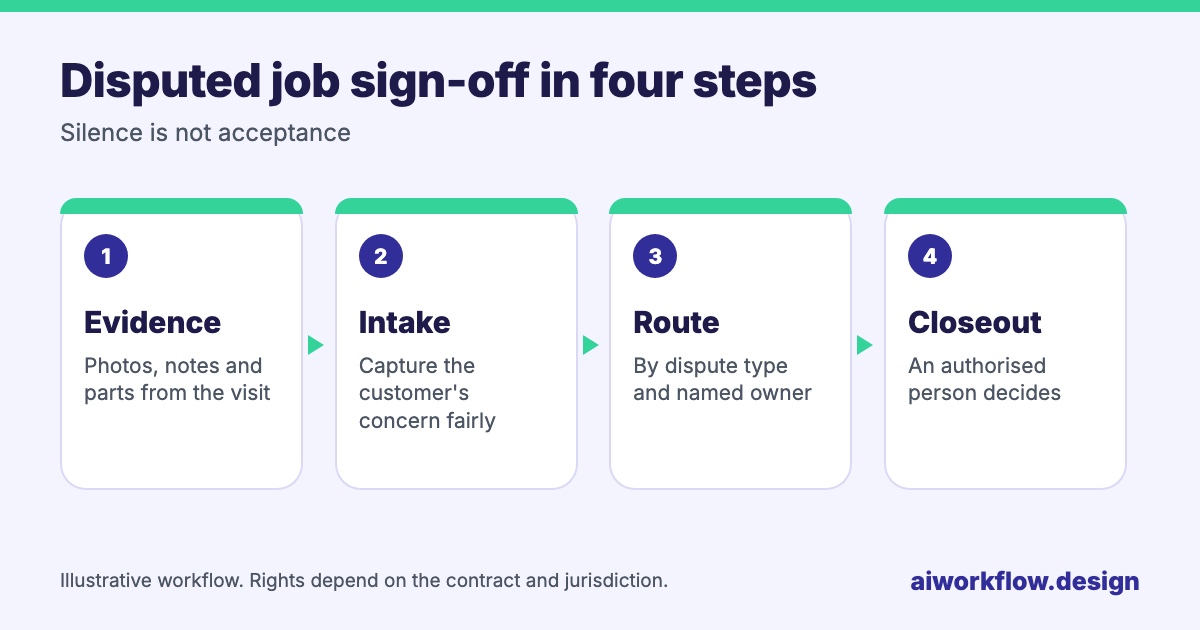
Define completion, acknowledgement and acceptance separately
Technician reported complete means the assigned worker records that the planned work was performed and submits the required service notes. It is evidence from a particular source, not proof of customer satisfaction. Customer acknowledged means the customer confirms receipt of information or participates in a handover; depending on the contract, acknowledgement may not mean acceptance of quality.
Dispute open indicates a specific concern, such as a suspected repeat fault, an omitted scope item, damaged premises or a disagreement about extras. Formally closed is an operational or contractual decision made by the appropriate person under the service agreement and applicable law. A single “Done” column is too blunt for these different events.
Separate commercial states as well: invoice prepared, invoice issued, payment disputed and payment received. Never infer payment entitlement solely from an automatically recorded call outcome; the underlying contract and legal protections still apply.
Collect a minimum evidence pack while the visit is fresh
Before a job moves into review, ask the technician for the work-order reference, equipment or area serviced, task completion notes, parts fitted, measurements or test results appropriate to the job, safety-related observations, site photos where authorised, customer instructions given and any limitations or recommended follow-up. Attach service reports in the normal secure record system.
Do not demand unnecessary personal photos or record conversations without following local privacy and consent rules. A service photo should demonstrate the work or condition being discussed, not become an unrestricted collection of household information or employee faces.
If a customer reports a concern, capture their own wording and the observable effect: “There is still water under the valve” is more useful than an agent-generated conclusion of “technician negligence.” Keep the original customer statement alongside any summary to avoid losing nuance.
Set a non-adversarial dispute intake process
The first response should acknowledge the concern, provide a case reference and state who will review it. Confirm the contact channel and any safety priority. Questions should be limited to what is needed to understand the issue: Which equipment or area is affected? What result was expected? What was observed after the visit? Is there an immediate hazard or loss of essential service?
Safety concerns require their own urgent route. A possible gas leak, live electrical exposure, flooding or loss of a critical system should not enter the ordinary “please reply in two days” queue. Follow the organisation’s emergency response and qualified technical escalation process instead of asking an AI assistant to diagnose the hazard.
Offer a way to submit photographs, documents or notes through the approved channel. Avoid pressuring a customer to “sign first and complain later.” A disputed signature carries little operational value and may damage trust.
Route the dispute by type, not by who complained loudest
Technical performance concern
An issue such as recurring noise, a failed test or poor system performance should go to a competent technical reviewer. They may schedule a diagnostic revisit, request more measurements or determine that a different fault exists. A status tracker should distinguish revisit requested from revisit authorised and revisit completed.
Scope-of-work disagreement
Check the approved estimate, variations and technician notes. If the customer believed a part was included, identify the signed scope and any documented change. A dispatcher should not reinterpret contract language or promise free additional work without authority.
Damage or property condition allegation
Preserve before-and-after evidence and identify who will investigate, including any insurer or risk team where appropriate. Do not edit the original service photos after a complaint. Record disputed facts neutrally until the designated reviewer reaches a decision.
Price, invoice or warranty dispute
Keep these in a commercial review lane with the applicable contract, warranty terms and jurisdiction-specific consumer protections. A technically satisfactory visit does not necessarily settle a pricing dispute. Equally, an unpaid invoice does not prove that the work was defective.
A clear job sign-off workflow in six stages
Use Work reported → Evidence submitted → Customer response requested → Accepted / Disputed / No response → Human review → Closed with decision. The No response state is a holding category, not a substitute for acceptance. Configure a follow-up interval from the business’s contract and service policy; do not invent a universal automatic-acceptance deadline.
Every disputed item should include an accountable reviewer, priority, next customer update, evidence link, action owner and review outcome. If a second visit is scheduled, it should have its own service record linked to the original case. That protects the audit trail and stops the second technician from overwriting the first visit’s notes.
When a customer later confirms satisfaction, record the new statement and close the concern through the designated policy. Retain the earlier disagreement; a clean current status must not erase the history of how it was resolved.
Example: a repaired air-conditioner still leaks
A fictional technician replaces a condensate component, tests the system and leaves photographs of a dry drain tray. The customer contacts the office the next morning saying water has appeared again. The record should show the technician’s test at the time, the customer’s later report and a new open issue, with no assumption that either account is dishonest.
The technical owner checks whether the original scope covered the new symptom and decides whether a priority return visit is required. The office updates the customer with the next action and timing only after the slot is agreed. Finance follows the applicable hold or billing procedure, if any. The workflow is complete when the responsible owner reaches and records a defensible outcome—not when the customer stops returning phone calls.
Where an AI follow-up can help
A controlled outbound call may confirm whether a customer received the service report, whether a promised visit has been arranged or whether an approved remedial task is reported as completed. It should offer a prompt route to a human if the customer disagrees or raises an urgent concern. Identify that the call is automated, respect communication preferences and do not record sensitive details in a shared board.
AI Workflow Design’s Daily Check-in Agent and other products support status collection; a customer-specific dispute intake or integration would require the appropriate custom workflow and review. Neither product should be presented as automatically adjudicating defects, assigning liability, authorising credits or meeting consumer complaint obligations.
Measure resolution quality, not automatic closure speed
Track time to first human acknowledgement, time to technical assessment, repeat visits, disputed work reopened after closure, percentage of closeouts with complete evidence and customer communication intervals. If an agent makes the board appear cleaner by marking unanswered cases “accepted,” the metric has become worse, not better.
Look for patterns. Repeated scope disagreements may suggest weak estimates; recurring documentation gaps may need better technician forms; long waits for a revisit may be an operational capacity problem rather than a communications problem. Use findings to adjust the actual service process.
Fair closeout protects both sides
Consumer-protection good practice encourages retaining repair orders, receipts and other documentation when disputes arise. While actual rights and obligations depend on the transaction and jurisdiction, the underlying operational principle is sound: preserve contemporaneous records, communicate clearly and keep decisions with authorised people. A good sign-off system makes disagreement visible early enough to resolve it without rewriting the history of the job.
Next step
Want these follow-ups handled consistently? Explore Autoza AI for monday.com or talk to AI Workflow Design about scheduled, permissioned status follow-ups that leave approvals with the right people.
Frequently asked questions
Can a work order be closed if the customer does not answer?
Follow the contract and approved company policy, but do not equate silence with affirmative acceptance. Keep the no-response state and any outstanding risk or dispute visible.
What is the difference between technician completion and customer sign-off?
Technician completion documents work claimed to have been performed; customer sign-off records an acknowledgement or acceptance with a meaning defined by the contract and form.
What evidence should be kept when service completion is disputed?
Original job scope, approved variations, service notes, relevant photographs, test results, customer communications, revisit reports and the authorised review decision.
Can AI decide that a service dispute is resolved?
No. It may collect a progress update or route an issue to a person, but technical findings, refunds, warranty treatment and formal closeout require appropriate human authority.
How should a repeat visit appear in the job tracker?
Create a linked visit with its own date, technician, findings, evidence and authorisation, while preserving the original record and complaint history.
Related reading
- Subcontractor Credential Checks: A Dispatch Readiness Workflow
- Emergency Parts Backorders: Keeping Field Service Customers Updated
- Warranty Service Follow-Up: Record the Right Evidence Before Closing a Job
- Field Service Photo Evidence: What to Request After a Job Update Call
- Second-Visit Jobs: Confirm Parts and Access Before Dispatching a Technician