
Quick answer: A hospital medical gas cylinder delivery checklist should confirm the authorised purchase or replenishment request, gas type and cylinder identifiers, supplier delivery window, secure receiving point, designated receiving staff, discrepancy record and escalation route. It supports logistics and stock accountability; it cannot substitute for qualified handling, clinical allocation, system-pressure management or emergency oxygen supply decisions.
A hospital department expects oxygen cylinders before the next scheduled delivery. The supplier says a truck is running late, the loading area is blocked and the ward asks whether it can borrow cylinders from another location. Three teams begin calling each other, but no one has one record that separates the logistical problem from the clinical and facilities risk.
A hospital medical gas cylinder delivery checklist is useful precisely because these responsibilities are not the same. The logistics team can confirm where a shipment is, receiving can verify what arrived and authorised technical or clinical personnel can decide what the disruption means for patient care. A generic AI call should not try to solve all three.
Identify the cylinder category and receiving control
First confirm the gas, intended use, approved supplier and relevant storage area. Medical oxygen, nitrous oxide and other compressed gases have different hazards and handling requirements. Do not treat a cylinder as an ordinary box: OSHA identifies fire, explosion and other risks and emphasises secure upright storage and proper handling for compressed gas cylinders in hospitals.
The receiving procedure should be based on the facility’s approved rules, applicable codes and supplier requirements. Confirm that trained receiving staff are available, that the delivery route is authorised and that temporary staging will not create a safety or egress problem. If the delivery involves bulk storage or piped-gas infrastructure rather than portable cylinders, use the separate engineered process that applies; do not reuse a portable-cylinder checklist without review.
Record only the information the authorised team needs: purchase-order or replenishment ID, requested gas type, expected quantity, delivery date, receiving owner, safe location, vendor reference, receipt status, documented exceptions and escalation path. Detailed stock levels for sensitive areas need access controls appropriate to the facility.
Separate shipment progress from usable stock
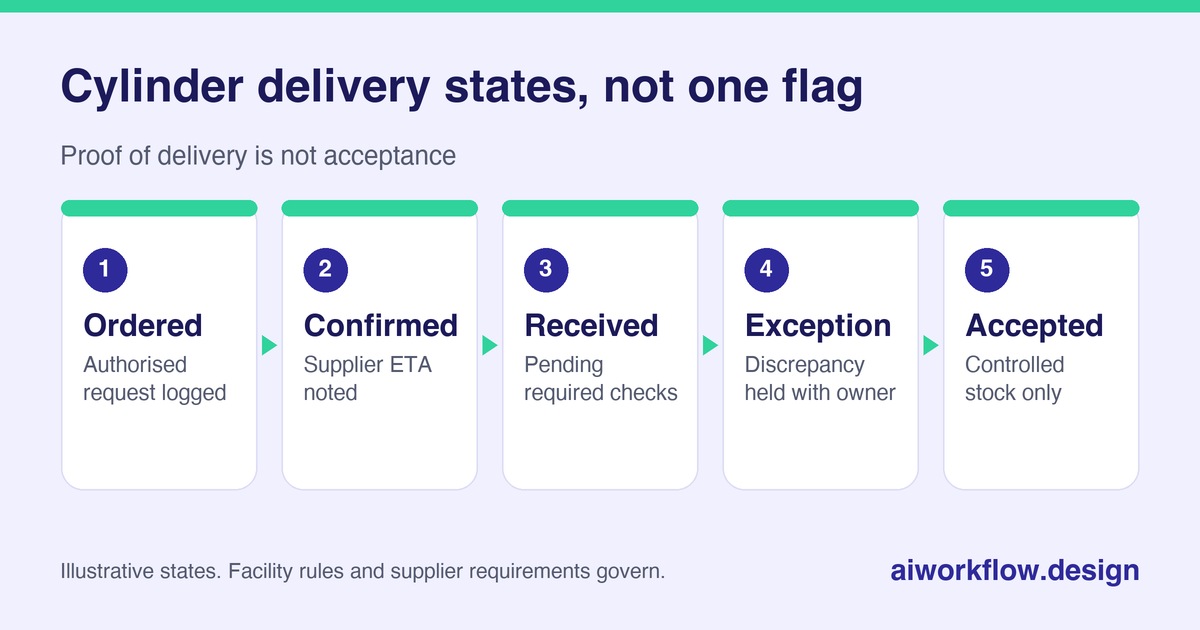
A supplier marking an order “Delivered” does not establish that the hospital received and accepted the correct goods. Receiving may find the wrong cylinder type, damaged packaging or valve protection, incorrect quantities, missing documentation or an unauthorised drop-off location. Those are discrepancies for trained staff to review under the facility procedure.
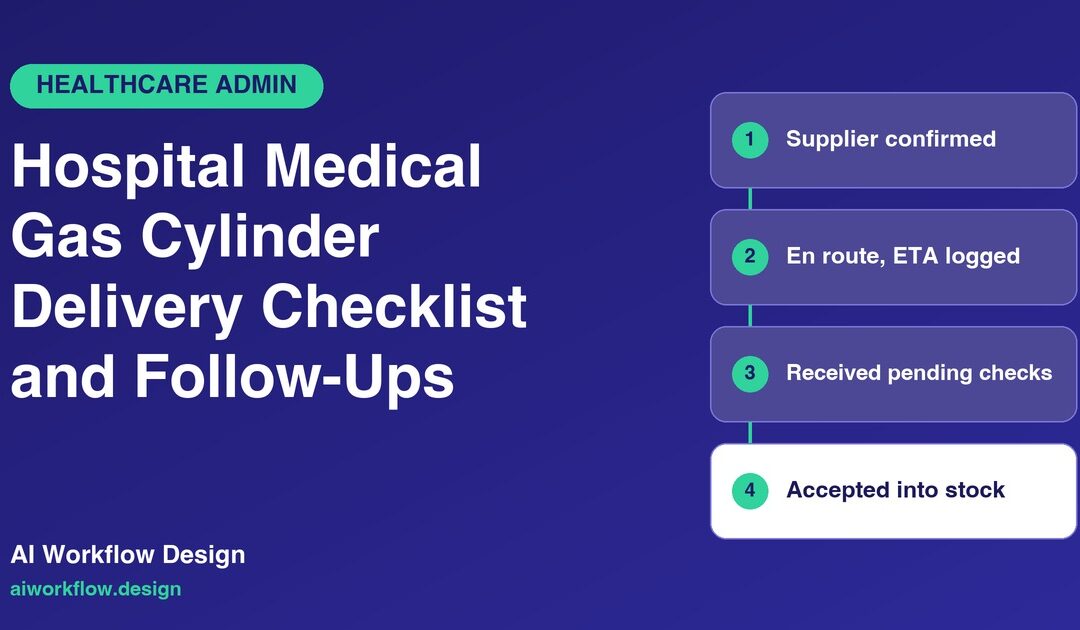
Use distinct states: Ordered, Supplier confirmed, En route, Received pending checks, Accepted into controlled stock, Discrepancy held, and Resolved. Do not automatically move a cylinder into available stock because a driver provided proof of delivery. Do not direct untrained staff to connect, transfer, decant or move cylinders to resolve a stock shortage.
The medical gas, safety and facilities teams should establish the policy for full and empty cylinder segregation, transport, identification and security. An administrative tracker can record evidence of completion; it should not become a handling instruction for personnel who are not trained.
Create a shortage escalation that starts with the right people
A delayed delivery becomes more serious when there are already stock constraints. The workflow should identify the appropriate on-call facilities, biomedical, respiratory therapy, pharmacy or clinical operations contacts based on the hospital’s own responsibility matrix. The specific roles vary by institution; configure the routing from its approved emergency plan.
When a supplier reports a delay, an automated notification can immediately alert the logistics owner. If that owner identifies possible patient-care impact, the case must escalate through existing clinical and emergency procedures. Do not calculate “hours of oxygen remaining” from a simplified spreadsheet or have a language model recommend rationing, cylinder substitution or system modifications. The hospital’s authorised professionals and validated systems must make those assessments.
Similarly, a missing supplier response is not evidence that a delivery will arrive on time. Preserve the last confirmed estimate, the time of confirmation and its source. A repeated estimated arrival time should be marked as an estimate until verified.
Organise the monday.com logistics board
One purchase or replenishment request can be the parent item, with subitems for supplier acknowledgement, transport update, delivery access, receipt check, exception resolution and invoice reconciliation. Include owners, evidence links and due dates. If departments use different stores, provide each location with a restricted view rather than a single open dashboard.
Keep clinical patient information out of routine logistics calls and public board comments. If the shortage affects clinical operations, record only the permitted escalation reference and the fact that the authorised team was notified. Leave patient-specific assessments within clinical systems.
A dashboard might display deliveries due today, supplier confirmations outstanding, receipts awaiting checks, discrepancies under investigation and recurring late-delivery patterns. It should not label the hospital “safe” or “unsafe” based solely on an inventory task status. It also should not infer acceptable stock from a delivery count without the facility’s approved validation.
Equipment maintenance evidence needs the same separation of logistics from technical acceptance; see hospital sterilizer maintenance records and medical refrigeration maintenance documentation.
Use structured check-ins with suppliers, not open-ended safety conversations
An AI status call can ask a supplier contact whether the delivery slot is confirmed, if a scheduled arrival time has changed, or whom receiving should contact. It can log a timestamped answer, notify the stock coordinator and ask for a human callback. A suitable question is “Has delivery reference MG-208 been dispatched?” An unsuitable question is “Can the ward safely continue operating with the cylinders on hand?”
AI Workflow Design’s products describe outbound check-ins and board updates. Those capabilities may help document vendor follow-ups when configured and approved, but they are not medical-gas compliance tools. For customised escalation routing between supplier messages and a hospital’s authorised logistics system, the services team describes integration work. Any healthcare deployment requires its own privacy, vendor-security and operational review.
Do not record cylinder valve instructions, access credentials or unnecessary sensitive details in voice transcripts. If a supplier reports a damaged cylinder or other hazard, end routine processing and immediately route the report to the trained site team.
Example: a partial oxygen cylinder delivery
A central receiving team orders 20 cylinders from an approved supplier. The vendor confirms the date but later reports only 12 available for delivery. The check-in system logs “partial shipment proposed” and notifies the supply owner. The supply owner consults the facility’s approved contingency process and clinical operations where needed. Receiving checks the actual shipment and marks 12 cylinders received pending required inspection. The shortfall remains open with an owner and supplier follow-up date.
At no point does a status agent declare that the 12 cylinders are sufficient, authorise substitution or instruct a clinical team to change how gases are used. Instead it provides accurate, timely information so trained people can act. That is a credible benefit of automation in a sensitive setting.
Review exceptions and supplier performance
Measure on-time supplier confirmation, on-time receipt, discrepancy frequency, time to resolve partial orders and percentage of exceptions with an assigned escalation owner. Investigate trends by delivery route or receiving window rather than increasing calls indiscriminately. Supplier performance discussions should rely on actual shipment and receipt evidence, not assumptions from automated transcripts.
The safest logistics workflow is one that makes delays and mistakes visible early while preserving the hospital’s existing technical and clinical controls. Better status information supports decisions; it must never impersonate them.
For related facilities workflows, see emergency generator test records and hospital water management follow-ups.
Next step
Want these follow-ups handled consistently? Explore Autoza AI for monday.com or talk to AI Workflow Design about scheduled, permissioned status follow-ups that leave approvals with the right people.
Frequently asked questions
What belongs on a hospital gas cylinder delivery checklist?
Include approved item and supplier details, receiving location, delivery window, trained receiving contact, expected quantity, receipt verification, discrepancy route and escalation owner under the facility’s procedures.
Is proof of delivery enough to release cylinders for use?
No. Acceptance must follow the hospital’s applicable receiving, identification, handling and safety processes. A delivery scan only confirms a logistics event.
Can AI manage a medical oxygen shortage?
It can alert designated logistics or operations personnel to a reported delay. It cannot assess patient-care sufficiency, prescribe substitutions or override emergency clinical procedures.
Should all cylinders be handled in the same way?
No. Requirements depend on gas type, equipment, applicable regulations and facility rules. Trained personnel should follow the correct procedures.
How should a partial delivery appear in monday.com?
Record what was ordered, what arrived, what is pending checks, the remaining quantity, the supplier’s documented next action and any escalation, with access permissions suited to the information.
Related reading
- Hospital Sterilizer Maintenance Records: Track Repairs Without Approving Clinical Release
- Medical Refrigeration Maintenance: A Non-Patient-Data Documentation Workflow
- Emergency Generator Test Records: A Facilities Evidence Follow-Up Plan
- Hospital Contractor Badges: Confirm Restricted-Area Access Before Work
- Hospital Water Management: Following Up on Sampling and Corrective Actions