
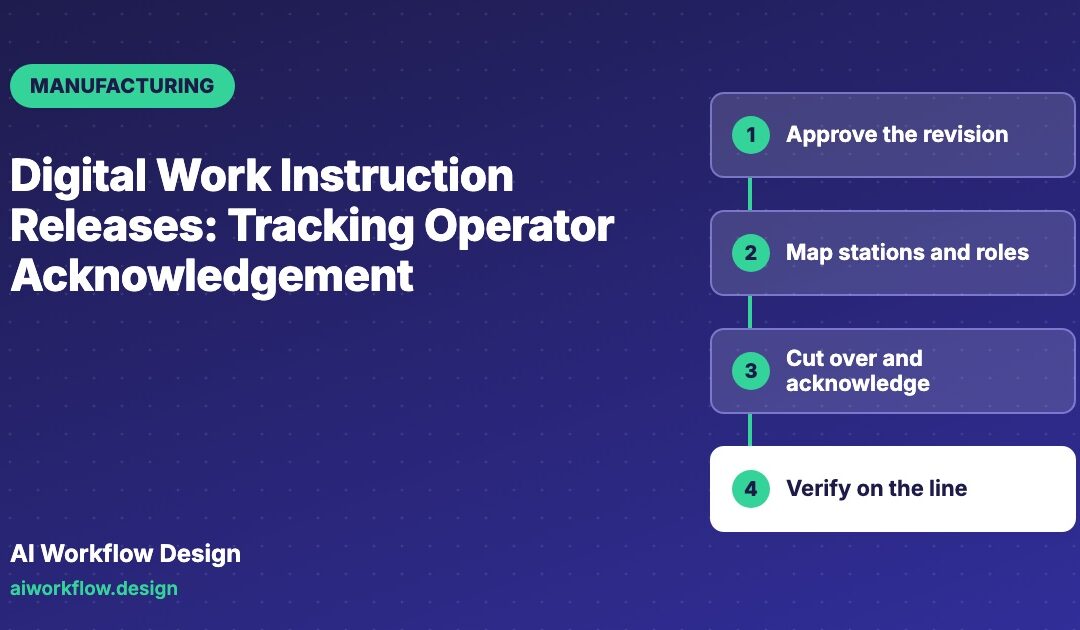
Quick answer: A strong manufacturing work instruction release checklist connects each approved procedure revision to the machines, products and shifts affected; confirms that the correct document is available at the point of use; records any required training and operator acknowledgement; and withdraws obsolete instructions through the controlled quality system. Reading a notification does not prove understanding, competence or permission to operate.
A revised work instruction can be perfect in the document-control system and still fail on the shop floor. One line has printed the old PDF, the night shift uses a screenshot of an earlier revision and a temporary employee follows a laminated card that nobody remembered to replace. Production may continue without anyone noticing that teams are building to different versions.
The challenge is not simply distributing a file. It is making a controlled change usable across real workstations, languages, job roles and shifts. The best release workflow treats document approval, deployment, comprehension and retirement of obsolete material as distinct milestones.
Establish the authoritative instruction and revision
Before release, identify the controlled document number, current revision, revision owner, change rationale, effective date, affected manufacturing process, approved language versions and any superseded documents. Record which authority signed off the revision. If the instruction refers to drawings, inspection plans or machine settings, verify the linked versions so the new instruction does not point operators to an obsolete standard.
Quality management expectations centre on consistent processes, accountability and clear controls. Use the company’s controlled document procedure and applicable customer or industry requirements to define the release evidence.
A document may be approved but not yet effective on a particular line. Make that distinction explicit instead of allowing a single “published” flag to imply operational readiness everywhere.
Map impact at station and role level
A revision to torque sequence may affect assembly operators, quality inspectors, team leaders, maintenance technicians and trainers differently. Build a release impact matrix covering site, line, station, part or process family, shift, operator role, language needs and training type. Identify the actual person or team responsible for confirming readiness at each station.
Do not assume every employee requires the same training. A wording correction might require a read-and-acknowledge action, while a changed machine setting may need a practical demonstration or competency check. The quality and training functions should determine what evidence is proportionate to the change and consistent with their QMS. Regulatory or customer rules may prescribe stricter requirements.
A practical matrix should also identify temporary workers and contractors who may not appear in the standard full-time employee list. If an operator joins after the effective date, the onboarding workflow must direct them to the current revision rather than a stale training pack.
Separate approval, publication, acknowledgement and competence
Use a release status that preserves the meaning of each step:
| Gate | What it establishes | What it does not establish |
|---|---|---|
| Document approved | Authorised content and revision | All stations have access |
| Published to controlled repository | Current revision available in official source | Old copies removed |
| Point-of-use verification | Correct revision displayed at assigned station | Operator competence |
| Acknowledgement recorded | Named person confirms receipt or required reading | Practical ability to follow change |
| Competency or training signed off | Required training evidence accepted | Every future execution is compliant |
| Release accepted | Designated owner confirms all required gates | Permanent elimination of human error |
This separation prevents a training dashboard from masquerading as a production release decision. A clicked acknowledgement button may be suitable for a low-risk editorial update but insufficient for a new safety-critical operation.
Use controlled delivery instead of uncontrolled attachments
Where possible, point operators to a controlled point-of-use display or document management system that resolves to the approved version. If printed copies are authorised, number them, identify locations and establish who withdraws them on revision. The system must work in the real shop-floor environment: readable screen size, protective covers, limited connectivity and language support matter.
Plan a withdrawal sweep for outdated laminated cards, binders, training slides, local downloads and shared-drive copies. When the old instruction must be retained as a historical record, label it clearly as superseded and restrict operational use. Removing history entirely can damage traceability; leaving it unmarked at the workstation can create quality risk.
Before effective date, have a line representative prove they can retrieve the correct instruction from the normal production position. A successful email distribution is not a point-of-use test.
Define training by the consequence of the change
A minor clarification might need a short huddle and documented acknowledgement. A revised inspection method could require supervised practice with test pieces. A machine or safety-control change may need formal qualification, updated risk assessment, authorisation and lockout or change-management steps as applicable. The instruction owner, trainer and quality authority should agree the required level before release.
Training records should capture person, role, document revision, training format, completion date, evaluator and any required result or competence decision. If someone cannot demonstrate the new method, record additional support rather than checking the training box to protect a launch date.
For multilingual operations, use translations that have been technically reviewed and approved. An automatic translation can introduce errors in measurements, negations or safety warnings. Treat translation quality as part of the controlled release, not an informal convenience.
Manage cutover across shifts without mixed versions
The effective-date plan must consider work-in-process and shift overlap. Specify when the last lot using the previous revision may finish, when the new revision becomes mandatory, whether material or tooling needs to be relabelled and who signs off the transition. If a production batch spans the cutover, the quality and process teams must approve how it will be handled.
Ask line leaders to verify readiness before the applicable shift starts. Use a named substitute where the usual leader is absent. If a critical station is not ready, escalate to the authorised process owner; an administrative reminder cannot authorise continued work under the wrong revision.
At shift handover, record which changes were communicated, unresolved operator questions and any observed use of obsolete instructions. The goal is not to flood operators with alerts. It is to create one reliable source of truth when the work begins.
Build meaningful acknowledgements and exception paths
An acknowledgement should identify the exact revision, person, time and method. Avoid “I have read all policies” bulk attestations that do not show which release was understood. If the change requires a competency test, store that result separately from acknowledgement. Provide a straightforward way to report unclear wording, conflicting drawings or unavailable training.
Exception states might include training scheduled, acknowledgement outstanding, competence review required, station copy not updated and effective-date hold. Resolve them through the relevant quality and production authorities. A manager may reschedule training but should not declare an operator qualified solely because a call reported that they had read the document.
Use administrative calls to chase readiness, not to replace training
A permitted status call can ask a team lead: “Has the current revision been deployed at station 4?”, “Which operators still need their assigned briefing?”, “Are any printed old copies awaiting withdrawal?”, and “Is there an unresolved question for the process engineer?” Keep the call brief and avoid collecting personal performance or disciplinary information beyond the approved scope.
An AI agent should not quiz operators on safety procedures, grade their performance or authorise machine operation unless a separately validated and approved training system explicitly supports that use. For high-risk instructions, qualified trainers and supervisors must perform the appropriate competency evaluation.
If someone reports that an outdated instruction is being used during an active process, follow the company’s immediate escalation or stop-work requirements rather than placing the issue in the next day’s administrative queue.
Connect monday.com to formal document control
A monday.com board can coordinate sites, workstations, shift leaders, revision identifiers, rollout dates and outstanding acknowledgements. It should link to the authoritative document control and training systems; it should not serve as a replacement for required approvals or competence records unless specifically validated for that purpose.
Autoza AI for monday.com can gather short rollout-status updates from named staff and write summaries to board items. Its published features include scheduled calls, retries and status logging—not controlled-document approval or training certification. For multi-platform workflows, AI Workflow Design’s custom automation services can be scoped with explicit version mapping and human-review gates.
A safe configuration only marks “station checked” when the authorised human confirms evidence in the official system. An automated call summary may surface the reported issue; it must never silently overwrite an official training or approval record.
Measure whether the revision actually reached the line
Useful indicators include stations displaying the correct revision at cutover, assigned operators with current training evidence, open obsolete-copy findings, time to resolve operator questions and production nonconformities linked to instruction ambiguity. Review these alongside quality outcomes. A 100% acknowledgement rate is not reassuring if a station still uses an outdated laminated instruction.
After release, ask supervisors and operators whether the document is understandable during real work. Improve the content where examples, illustrations or sequencing are unclear. A digital release process should reduce friction while preserving traceability, not add another disconnected checklist.
Manufacturing work instruction release checklist
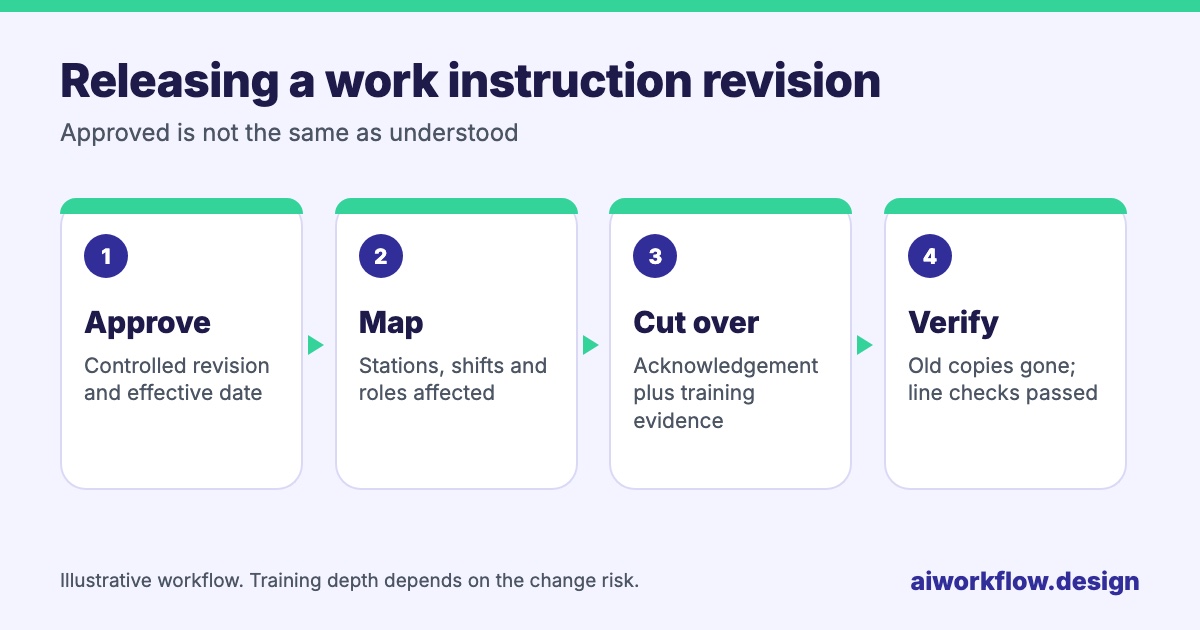
- Verify the authorised document number, approved revision and effective date.
- Map affected lines, stations, roles, shifts and language versions.
- Set training or competency evidence requirements based on the actual change.
- Publish the current instruction in the controlled point-of-use system.
- Withdraw or mark obsolete copies without destroying required history.
- Complete cutover and work-in-process handling under approved controls.
- Record acknowledgements and unresolved competence exceptions separately.
- Obtain the designated production and quality release decision before full adoption.
A work instruction is truly released when the correct people can use the correct version correctly—not when an email says “document updated.”
Next step
Want these follow-ups handled consistently? Explore Autoza AI for monday.com or talk to AI Workflow Design about scheduled, permissioned status follow-ups that leave approvals with the right people.
Frequently asked questions
What is required in a manufacturing work instruction release checklist?
Include approved revision and effective date, affected stations and roles, controlled point-of-use access, withdrawal of obsolete copies, assigned training, documented acknowledgements, required competence evidence and final release approval.
Is an operator acknowledgement the same as competency sign-off?
No. Acknowledgement records receipt or reading of a specified instruction. A competence sign-off, where required, needs the organisation’s approved training and evaluation evidence.
How do we avoid old work instructions on the shop floor?
Use controlled access at the point of use, manage authorised print copies, carry out a withdrawal sweep and verify active stations against the approved revision before cutover.
Does a quality standard automatically require every operator to sign each revision?
Not as a universal blanket rule. The organisation should follow its applicable QMS, relevant standard requirements and risk-based training procedure. Different revisions may need different forms of awareness and competence evidence.
Can AI check-in calls replace operator training?
No. They can report rollout readiness and missing acknowledgements. Technical explanation, practical assessment and formal authorisation should stay with qualified trainers and quality or production authorities.
Related reading
- Temporary Process Deviations: Who Can Authorise Manufacturing Exceptions?
- Production Changeovers: How to Track Each Owner Before the Next Shift
- Engineering Change Orders: Tracking Manufacturing Approval Dependencies
- Pilot Production Readiness: A Follow-Up Plan Before Ramp-Up
- Overdue Equipment Calibration: A Manufacturing Follow-Up Plan
- Production Line Changeovers: A Material and Tooling Readiness Checklist