
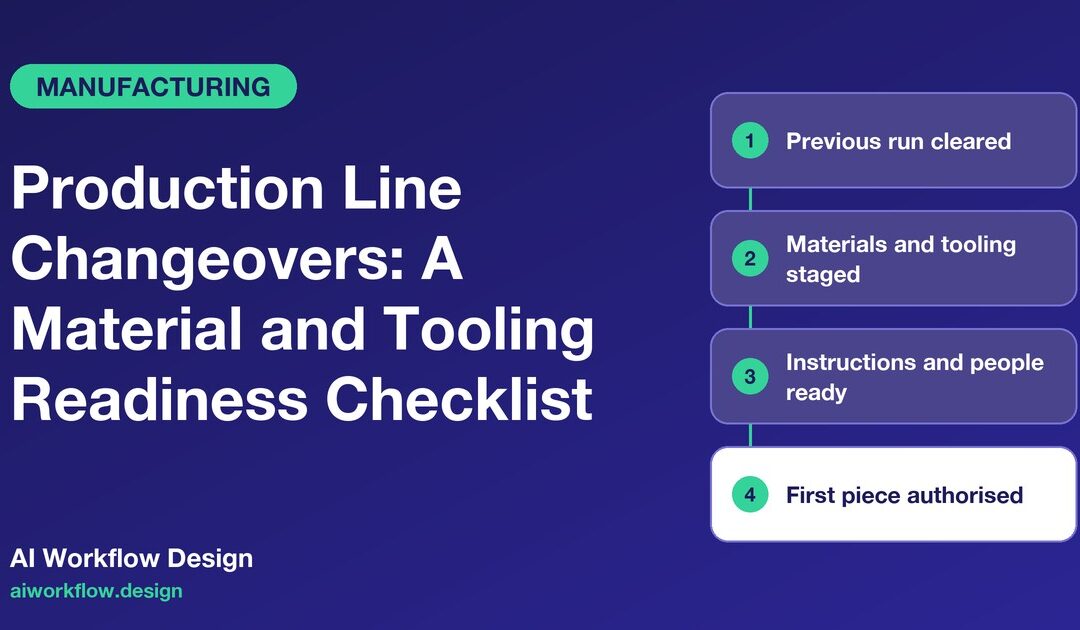
Quick answer: A production line changeover readiness checklist confirms that the previous run is properly cleared, the next product’s materials and tooling are available, the correct work instructions are in use, qualified people and inspection resources are ready, and a designated person authorises the first production run. Status follow-ups can collect readiness information; they must not bypass lockout procedures, quality checks or safety-critical start-up approvals.
A line can lose hours between two products even when the machine itself takes only minutes to reset. The next die is in a different building; labels from the previous batch remain at a packing station; maintenance is still adjusting a guide; the quality technician has not received the new drawing. Operators may report that the equipment is “ready,” yet one missing element prevents safe and compliant production.
A useful manufacturing changeover checklist makes those dependencies visible before the final good unit of the current run leaves the line. The purpose is not to turn every manufacturing decision into a board tick box. It is to get materials, tools, people and documentation to the right place so the approved procedure can proceed without avoidable waiting or confusion.

Distinguish changeover preparation from equipment intervention
Lean manufacturing distinguishes between external preparation that can be done while equipment is running and internal steps that require a stopped machine. The NIST Manufacturing Extension Partnership describes quick changeover as reducing the time between the last good piece of one run and the first good piece of the next. That is an improvement goal, not an instruction to rush machine isolation or safeguards.
Classify each task accordingly. Material kitting, approved documentation checks, booking a technician and confirming that a replacement tool is available may be planned ahead. Removing guards, changing dies, adjusting energy sources or clearing a hazardous jam must follow the site’s safety procedures with authorised people. A planner’s status call must not be construed as a permit to enter a machine or override lockout/tagout requirements.
Plan backwards from the scheduled changeover
Start with the next product, order or batch and list what must be true before the line can restart. Identify the target product revision, required raw materials, packaging, labels, fixtures, jigs, tools, measurement equipment, software settings and trained operators. Confirm who is responsible for each item, when it is needed and what evidence counts as ready.
A staged time line might have a planning review several days in advance, a kitting check before the last production shift, and a final pre-start meeting at the line. These are example planning checkpoints; each plant must establish its own schedule based on changeover complexity, batch control and safety. Avoid one-size-fits-all deadlines that encourage people to mark a task complete before the material actually arrives.
Verify the previous run is truly finished
Before preparing the next item, the team must know what to do with unfinished product, remaining labels, work-in-process, rejected material and open quality issues from the previous job. A quantity reconciliation or product-clearance check may be required under the plant’s quality system. The planner can chase the completion status, but the authorised production and quality personnel must make the relevant clearance decision.
The checklist should point to a controlled run-end record, not reproduce sensitive formulation, traceability or inspection details on an open board. An unchecked “previous labels removed” item may be a material risk in packaging environments. An unclosed deviation may affect whether changeover is permitted. Do not silently hide these exceptions to protect a start-time target.
Make materials and tooling a verified handoff
For materials, capture the required part number and revision, authorised lot or batch status, quantity, staging location and the person confirming availability. Distinguish “warehouse has stock” from “the right material has been issued and staged at the correct line.” Material substitutions must follow the organisation’s approval procedure. A shortage should generate an escalation to planning and quality, not an automated suggestion to use a similar part.
For tooling, confirm the tool ID, current service condition, location, compatibility with the product revision and whether special maintenance or calibration is needed. A tool marked available in inventory might still be reserved for another line or awaiting inspection. Create a simple readiness distinction: requested, located, inspected or approved where required, and staged. That status model prevents a green board from concealing a missing fixture.
Confirm the correct instructions and operator capability
Check that operators and supervisors can access the active, controlled version of the setup instruction and any applicable quality plan. If a product revision changed, confirm what was revised and whether acknowledgement or training is required. Prior training on an earlier setup does not automatically qualify someone for a changed operation. Staffing coverage should also include maintenance, material handling and inspection roles needed for the specific shift.
Do not treat an AI call saying “I read the procedure” as formal training evidence unless the approved training system explicitly recognises that record. A supervisor or authorised training owner must resolve gaps. For high-risk activities, ensure the safe-work requirements, permits and competent personnel are in place before tasks begin.
Put the changeover on a monday.com readiness board
Create one item for each planned line changeover, with Product from/to, Scheduled start, Line, Planner, Production supervisor, Tool owner, Material owner, Quality owner, Previous run clearance, Materials staged, Tooling ready, Instructions current, Training status, First-piece inspection and Start authorisation. Link to the approved production-order and quality records rather than duplicating those controlled records.
Use groupings such as Planning → Pre-stage → Equipment stopped and controlled → Setup in progress → First-piece review → Approved production / Hold. Each group should show the source and owner of its evidence. Make “On hold” a visible outcome, not an embarrassing exception. Keep the final authorisation action outside an automated status-mapping rule.
Where scheduled AI check-ins help
A short status call to the toolroom lead can ask whether the specified fixture has been staged. A call to materials control can ask if the correct issued materials are physically at the line. These answers can update a monday.com item as reported readiness, with a timestamp and assigned follow-up if the answer is unclear. Autoza AI for monday.com can support such task-owner calls and mapped board notes. Teams using other tools can explore the Daily Check-in Agent for routine, approved status collection.
No status bot should give safety instructions, recommend bypassing guards, authorise machine restart, resolve a quality nonconformance or declare a product acceptable. These decisions belong to trained staff and the plant’s governed procedures. If a caller reports an immediate hazard, escalate to the site’s established emergency or safety process rather than allowing the agent to troubleshoot it.
Worked example: packaging line switches to a new SKU
A hypothetical packaging team plans to switch from a blue-label product to a green-label variant after the afternoon run. The previous day, the materials team confirms stock but has not staged the green labels. The planner sees the discrepancy on the changeover board. A status follow-up with materials identifies that the labels are in an off-site store; the transfer is booked before the scheduled line stop.
At the changeover, an operator discovers leftover blue-label reels at a secondary station. The supervisor places the line on hold and follows the approved line-clearance procedure. Quality verifies the required condition and documents the decision. Only then does the line proceed to setup and first-piece assessment. A readiness board saved the team a material delay, but it did not substitute for the more important physical clearance and independent checks.
Measure avoidable waiting and right-first-time readiness
Track the number of late material arrivals, tooling shortages, incorrect-document findings, changeovers delayed by staffing gaps and first-piece rework. Record actual start and completion times if the plant needs to study setup duration. Separate delays that result from necessary safety or quality holds from avoidable preparation failures. A goal of reducing changeover time should never become an incentive to shortcut mandatory procedures.
Review repeated failure patterns with planners, operators, maintenance and quality together. If the same fixture repeatedly goes missing, fix its storage or booking process. If the wrong instruction version is often printed, improve document control. The best automation opportunity is the recurring, predictable handoff—not the expert judgment required at the machine.
Next step
Want these follow-ups handled consistently? Explore Autoza AI for monday.com or talk to AI Workflow Design about scheduled, permissioned status follow-ups that leave approvals with the right people.
Frequently asked questions
What should a production changeover checklist include?
It should cover previous-run clearance, upcoming product and revision, required materials, tooling, approved instructions, staffing, safety prerequisites, equipment setup and first-piece or start authorisation as specified by the plant’s procedures.
What is the difference between internal and external setup work?
External preparation can occur while the machine continues an authorised operation, such as staging the next tool. Internal setup requires a stopped or otherwise controlled machine. The distinction never overrides lockout, safeguarding or permit requirements.
Can a planner mark tooling ready because stock records show it available?
Not necessarily. Physical location, condition, compatibility, reservation and any required inspection must be checked. A stock count is not proof that the correct tool is ready at the line.
Can AI approve the first production unit after changeover?
No. An AI check-in can collect progress updates but cannot replace approved inspection, release or operator-authorisation procedures.
How should a changeover delay be reported?
Record the specific blocker, owner, expected next update and whether the delay is due to planning, materials, tooling, safety or quality. Escalate safety and quality concerns through the proper channels rather than treating them as routine overdue tasks.
Related reading
- Digital Work Instruction Releases: Tracking Operator Acknowledgement
- Pilot Production Readiness: A Follow-Up Plan Before Ramp-Up
- Maintenance Spares Readiness: Confirm Critical Components Before Downtime
- Overdue Equipment Calibration: A Manufacturing Follow-Up Plan
- Missing Batch Records: Track Evidence Before Production Release