

A multi city event logistics checklist needs two parts: a standard operating package that travels with the roadshow and a local readiness record for every stop. The repeated programme might have the same demo stations, signage and agenda, yet venue access, permits, delivery windows, local staffing and equipment change from city to city. An effective follow-up plan keeps those differences visible without asking every vendor to answer the same unnecessary questions.
A common roadshow mistake is to copy the first event board and assume that because a task was finished in City A, it will be finished in City B. The organiser later discovers that the second venue has a different loading dock, local electrical rules or booking restrictions. Repeatability should mean a tested process—not copied confirmations.
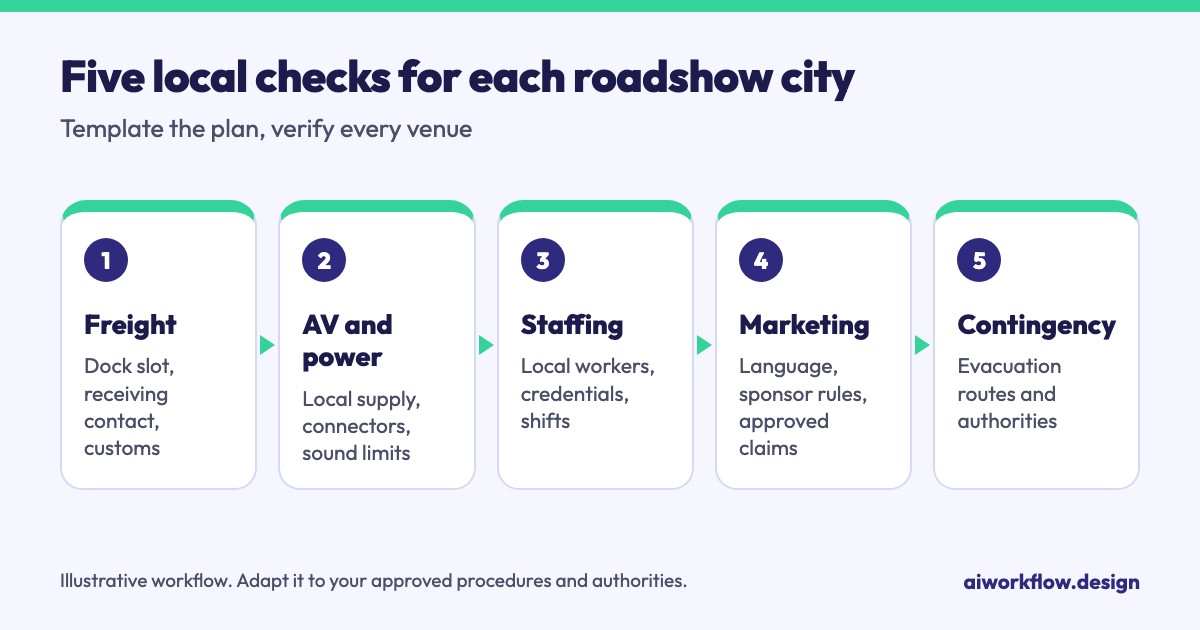
Divide the roadshow into a central kit and individual city requirements
Maintain a single master programme with the approved event format: agenda, brand kit, production drawings, digital assets, staffing roles, standard supplier brief, run-of-show and reporting rules. Use a separate city-level workstream for venue agreement, load-in windows, local contractors, audience permissions, insurance evidence, permits and delivery addresses. The central team should own the format; each local production lead should own verification for their stop.
Cvent describes roadshows as a repeatable event format supported by reliable logistics and local partners. That framing is useful because it makes a clear operational distinction: standardise what can genuinely be repeated, then verify everything shaped by the local venue or jurisdiction. Do not mark a permit or safety approval as complete because a previous city obtained one.
Build a city readiness matrix with an explicit owner
| Control point | Reusable programme element | Must be verified locally |
|---|---|---|
| Event agenda | Session sequence and production brief | Venue operating hours and local audience needs |
| Freight | Approved packing list and labels | Address, receiving contact, dock slot, customs if applicable |
| AV and power | Standard technical rider | Local supply, connectors, sound limits and competent sign-off |
| Staffing | Role descriptions and call scripts | Local workers, credentials and shift coverage |
| Marketing | Master creative and event registration flow | Market language, local sponsor rules and approved claims |
| Contingency | Escalation framework | Venue evacuation procedures, emergency contacts and authority |
Give every control point a named receiving owner who accepts the handoff. A project manager can collect updates but should not replace venue permission or an authorised technical inspection with a checkbox. For large programmes, add a “repeat from previous city?” field, but make it an explicit review prompt rather than automatic approval.
Schedule follow-ups around handoffs between cities
The most valuable call windows occur when responsibility changes. Before dispatching the touring kit, ask the shipping lead whether the packing list, serialised items and destination contacts are confirmed. Before local load-in, ask the venue representative whether the slot and access instructions are still valid. Before technical rehearsal, ask the local AV lead whether required equipment and power arrangements have been verified. After an event, ask the receiving city who has accepted the returned or transferred kit.
An illustrative three-stop tour might use a baseline review two weeks before each stop, a logistics check several days before arrival and a final owner-to-owner handoff close to load-in. Those dates are examples, not universal requirements. The appropriate intervals depend on freight transit, venue rules and the consequences of a late answer. If a city has a public holiday or international shipment, schedule around the real dependency rather than the marketing calendar.
Ask five questions that uncover hidden city-level assumptions
A concise vendor follow-up should ask: What is confirmed? What evidence or booking reference supports it? What is still dependent on someone else? What changed since the last update? Who must respond next, and by when? Add a specific question about local site access when the vendor handles freight or installation. Keep customer personal data, payment credentials and sensitive venue security details out of routine AI calls.
Suppose a venue replies that the loading slot is provisionally held. Record that exact qualification instead of changing the board to confirmed. Ask for the authority or document needed for final confirmation, then assign the issue to the local logistics lead. If the venue changes the slot, the team should update the freight and AV dependencies, rather than asking those suppliers to work from an outdated run sheet.
Design a monday.com board that prevents copy-forward errors
Create a master tour board for shared milestones and one city board or group per stop. Proposed fields include City, Local owner, Vendor, Critical dependency, Scheduled contact, Last verified, Evidence reference, Exception owner and Human approval status. The statuses should make the difference between reported, documented and authorised visible. Do not use one status column for both vendor progress and venue permission.
Boards can be linked to shared kit tasks and shipment dependencies. Where access to commercially sensitive details is limited, review monday.com’s board and column permissions. This example is a suggested operating design, not an installed Autoza template. AI Workflow Design describes Autoza AI as scheduled check-in calling linked to monday.com; the local process, authorised fields and escalation rules must be agreed during configuration.
Reduce vendor fatigue by updating only what changed
Ask a question once when the answer is durable and supported by evidence. Recheck only at a meaningful milestone or when a dependency changes. A local caterer may not need three calls about an approved menu, while a freight provider with a moving arrival window may require a same-day human check. Distinguish a planned check-in from an urgent escalation and let vendors know the caller’s identity and purpose.
A practical rule is to avoid contacting a supplier again merely because another supplier missed its update. Instead, inspect the dependency: did the missing update change that supplier’s role? If yes, communicate the specific change. If not, leave the confirmed task alone. Build reasonable contact times and opt-out procedures into the plan, and confirm legal obligations for automated calls across countries or states.
Close each city before launching the next one
At the end of a stop, record lost or damaged kit, venue charges, supplier exceptions, transport departures, final assets and any audience feedback that should alter the playbook. Assign the revisions to the central production owner. Do not overwrite the historical record for City A with the new plan for City B. A short city closeout note can be more useful than a long generic lessons-learned presentation.
The existing guide to vendor readiness calls covers single-event preparation. A roadshow adds transfer ownership, repeated city-specific verification and a record of what must not be copied forward. Teams using monday.com can review scheduled call workflows with Autoza to see whether routine local supplier updates are a good fit.
Frequently asked questions
Which roadshow tasks can be templated across cities?
The approved agenda, technical brief, brand kit, contact roles, core packing list and reporting process can often be standardised. Venue permissions, local suppliers, access arrangements and jurisdictional requirements require city-by-city confirmation.
What must be checked locally before each roadshow stop?
Verify the venue contract and operating windows, loading access, local production and staffing, permits or insurance requirements, accessibility, power and network arrangements, freight receiving and emergency procedures.
How can an organiser avoid repeated vendor calls?
Give each call a specific unanswered question or changed dependency. Keep evidence and last-verified dates on the board so the team does not repeatedly request information that remains valid.
Should roadshow organisers use one board or many?
A master programme with separate city workstreams is usually easier to govern than one undifferentiated task list. The correct structure depends on vendor access, team size and the need to compare progress across locations.
Can an AI caller approve a local venue’s operating requirements?
No. It may capture what an authorised local person reports, but permits, venue permissions, safety sign-offs and technical approvals must come from the responsible people or authorities.
Repeat the roadshow plan without repeating vendor chasing
Explore scheduled AI check-ins for monday.com to update only what changed in each city while local venue and safety approvals stay human-led. See the pricing page or browse more industry workflows.
Related reading
- Event Weather Contingency: Task-Owner Check-Ins Before an Outdoor Show
- How to Run Vendor Readiness Calls Before a Major Event
- Building a Run-of-Show Follow-Up Schedule Across Multiple Vendors
- Venue Access and Load-In: Who Confirms Each Event Logistics Milestone?
- Exhibitor Move-In Deadlines: A Pre-Show Follow-Up Checklist