

Quick answer: A tooling maintenance handover checklist confirms which tool or machine was serviced, what work was performed, which hazards remain controlled, whether technical checks and documentation are complete, and who is authorised to return it to production. A status call can confirm that a maintenance report is ready or a technician is available; it cannot remove lockout devices, certify guarding, approve a first-piece inspection or restart equipment.
A press is back from maintenance and production needs it for the afternoon shift. The maintenance ticket says “finished,” but an operator finds a protective guard still removed. The supervisor assumes the engineer checked everything; the engineer assumes operations will do the startup checks. The tool has physically returned, but it has not necessarily been handed back safely.
A tooling maintenance handover checklist closes that gap without confusing reporting with authorisation. The same principle applies to dies, fixtures, CNC tooling, injection moulds and equipment that requires inspection, guarding or validation after service. The exact controls vary with the equipment, hazard and jurisdiction; the site’s documented maintenance and safety procedures always govern.
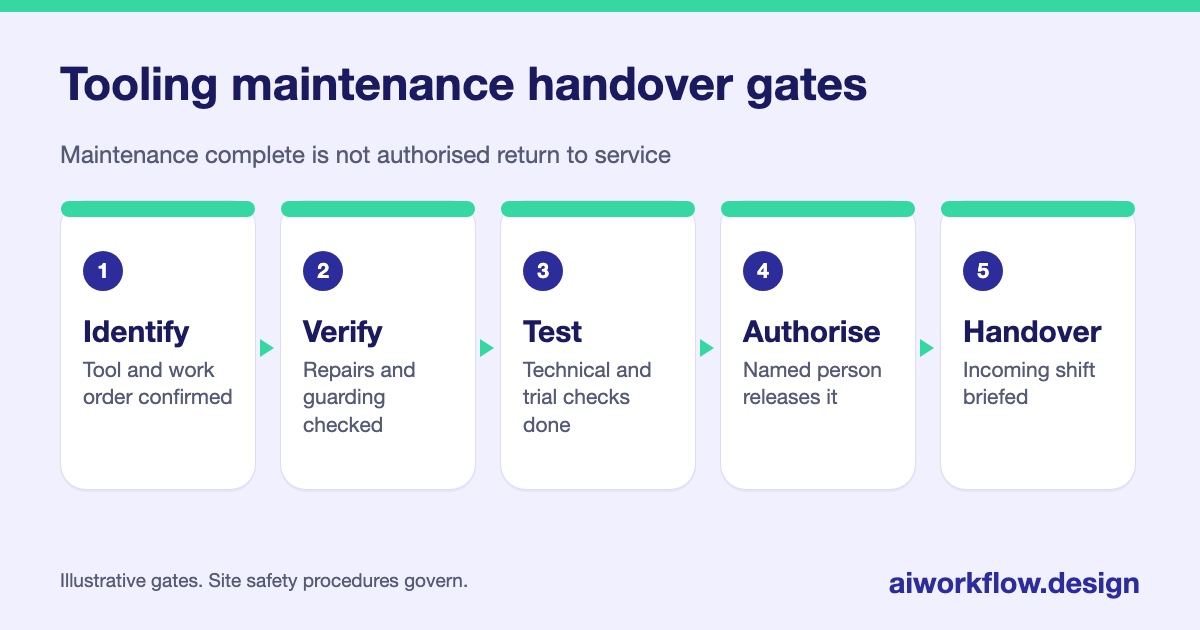
Distinguish a completed repair from authorised return to service
Maintenance completion can mean a technician finished the assigned work. Return to service is a separate sequence: required safeguards are restored, tools and people are clear, energy-control requirements are satisfied by authorised staff, technical checks pass, operations accept the equipment, and production performs any mandated first-piece or process checks.
The Occupational Safety and Health Administration’s hazardous energy control standard sets requirements for protecting people from unexpected energisation during servicing and maintenance in covered U.S. workplaces. It includes specific roles and procedures around lockout/tagout. Nothing in a scheduling workflow should be interpreted as permission for an unqualified person or an AI system to bypass those requirements.
Build the handover around actual stages, not one checkbox. Useful states include reported repair complete, maintenance review pending, safety controls verified by authorised personnel, technical test accepted, production trial pending, and released by the designated authority. Keep a separate “not suitable for use” state and clear escalation rules.
Start with a precise asset and work-order identity
Record the asset number, tool or fixture identity, location, equipment configuration, issue reported, maintenance order, technician, service window and affected production order. Where interchangeable tools look alike, serial numbers and configuration identifiers prevent the wrong item from being returned.
The maintenance report should describe work performed, replacements, outstanding concerns, measurements or tests where relevant, and recommended follow-up. A ticket that says “done” without a traceable work order and equipment identity should be sent back for clarification. Parts removed or replaced may require controlled records for reliability or warranty tracking.
Document whether the work changed the process or tool configuration. A repair that restores a previous approved state may have a different review pathway from a modification affecting machine parameters, dimensions or safety controls. Engineering and quality should determine whether additional qualification or first-piece inspection is required.
Design the handover around four independent checks
Safety check: Have the authorised personnel followed the applicable energy-control, guarding, access and workplace procedures? Maintenance check: Is the work order technically complete, with tests and unresolved issues recorded? Production check: Can the asset perform the intended task within approved operating conditions? Quality check: Are any required tool qualification, first-piece, measurement or process-verification records accepted?
Each check requires a named role and evidence type. The maintenance engineer may be competent to validate a repair while the production supervisor confirms operating readiness and quality approves the first-piece result. They should not silently approve one another’s duties just because the asset is urgently needed.
OSHA’s machine-guarding safety guidance describes steps required to return equipment to service after maintenance, while its lockout/tagout tutorial addresses special procedures for testing during servicing. Those are technical controls; a project board only records their authorised status.
Handle return-to-service exceptions without pressure to restart
A machine can test correctly while the operator has not been trained on an approved parameter change. The technical repair may be accepted, yet operational readiness is still incomplete. The correct next step is to identify the training owner and approved procedure, not to pressure the operator into acknowledging that everything is fine.
If there is a reported immediate safety concern, stop routine follow-up and use the site’s emergency or safety escalation. Never ask a worker to approach moving equipment or perform tests while speaking to a bot.
Make shift changes a visible part of the process
Tooling often moves between shifts. A late service ticket can leave the incoming supervisor unaware that an asset remains out of use. The handover record should show the responsible outgoing and receiving owners, last verified state, outstanding restrictions, needed parts or tests, and next review time.
Use positive acceptance, not silence. If nobody replies to the handover message, keep the asset in its existing controlled state and escalate through the supervisor. Do not infer that the equipment was accepted because production started using it. A known defect or incomplete safeguarding requirement is not an administrative delay that can be waived by a missed call.
A sensible contact cadence follows the repair milestone and shift boundary: confirm readiness for inspection, notify the designated reviewer, then obtain an approved disposition. Routine daily calls to every technician waste time when there is no outstanding handover task.
How to coordinate on monday.com
Create one board item per maintenance handover with the work order, asset ID, responsible technician, receiving production owner, target date, reported repair state, safety review status, quality review status, evidence reference, blocker and final approved disposition. Separate permissions for changing “reported complete” from permissions for recording “released”. The authoritative maintenance, safety and quality records should remain in their respective systems.
AI Workflow Design describes scheduled operational check-ins and monday.com-related products. A carefully scoped call can ask whether a handover packet was sent, whether a supervisor can attend the review or what logistical issue blocks a test. It must not provide procedural instructions for hazardous work, certify machine condition or change a formal release state.
For an adjacent example, the existing guide on manufacturing production line changeovers can help teams think about parts, tooling and staff dependencies. The actual controlled manufacturing instructions govern any restart.
Close with a verifiable operational decision
Measure the time from repair completion to accepted production return, handovers awaiting independent checks, repeat breakdowns after maintenance, and delays caused by missing parts or paperwork. Keep safety and quality exceptions visible even when they make throughput look worse; hidden exceptions are not improvements.
Before the asset resumes production, the designated people should confirm safeguards and required checks under site procedures, record any special operating conditions, and communicate the decision to the receiving shift. The handover succeeds when the next person knows exactly what was done, what is still restricted and who authorised the return—not when the task board simply turns green.
A practical receiving-shift sign-off sequence
At handover, the maintenance lead should identify the actual asset and work order and state which tasks are finished and which restrictions remain. The authorised safety and equipment owners then perform their applicable checks according to the site procedure. Production confirms who will operate the asset and under what approved settings. Where required, quality or process engineering reviews the first-piece or trial result. The receiving supervisor records whether the current state is approved for normal operation, approved under documented restrictions or still on hold.
If another contractor or shift must finish the work, transfer the open actions explicitly instead of marking the job complete. A new operator should never have to infer safe operating conditions from the absence of a warning on a dashboard. Before automating reminders, test what happens when a service report is missing, an authorised reviewer is absent and a test fails. The expected result in each case is a visible hold and a named escalation—not a premature restart.
Next step
Want these follow-ups handled consistently? Explore Autoza AI for monday.com or talk to AI Workflow Design about scheduled, permissioned status follow-ups that leave approvals and decisions with the right people. For a companion workflow, read Supplier First Article Inspection: Track Documents Before Quality Approval.
Frequently asked questions
What is a tooling maintenance handover checklist?
It is a controlled record of repair completion, relevant safety and technical checks, production acceptance, unresolved restrictions and the person authorised to return equipment to use.
Can a completed maintenance ticket authorise production restart?
No. Restart may also require authorised energy-control procedures, safeguarding, machine checks, operator readiness and quality or first-piece acceptance under site rules.
Can AI remove lockout/tagout or approve a machine as safe?
No. Energy control and technical safety decisions belong to trained authorised employees following the applicable procedure. AI status calls can only handle permitted administrative coordination.
What happens when a repaired tool fails its production trial?
Keep the tool in the appropriate controlled hold state, assign the maintenance or engineering owner, document the failed result and require the authorised recheck before restart.
What should the incoming shift receive?
The asset identity, work-order reference, approved current state, remaining restrictions, required checks, named receiving owner and evidence of any formal release decision.