
Quick answer: A concrete pre-pour inspection checklist should connect each required hold point to an authorised inspector, the latest approved drawings, a dated inspection record and a clear release decision. Project check-in calls can identify missing reinforcement checks, formwork issues or unavailable inspectors, but they cannot clear safety or quality hold points or authorise concrete placement.
A concrete pour is a sequence of decisions, not a calendar event
Concrete placement is difficult to reverse. Once the pour begins, a buried sleeve, displaced reinforcing bar or missing inspection can become an expensive defect and an argument over responsibility. That’s why useful pre-pour readiness means more than asking whether the site “looks ready.” It is a defined set of documentary, technical and logistical checks, with named people authorised to release the work.
The scope varies with structural design, project contract, local building controls and the type of pour. For U.S. projects, OSHA’s cast-in-place concrete rules set requirements relating to formwork, shoring and reinforcement safety. A government quality-assurance example from SCDOT illustrates how pre-pour documentation and approval can be established as a hold point on a specific contract. Neither source replaces the approved inspection and test plan for your job.
The right workflow distinguishes three states: work reported complete, work inspected, and work formally released. A status update cannot automatically move an item from the first state to the third.
Build an inspection matrix before the first truck is booked
For each pour zone, create a separate readiness record. Give it a location, revision reference, targeted concrete delivery window and a decision owner. Avoid using one undifferentiated “Concrete ready” status across multiple slabs or footing areas; some areas may be released while others remain blocked.
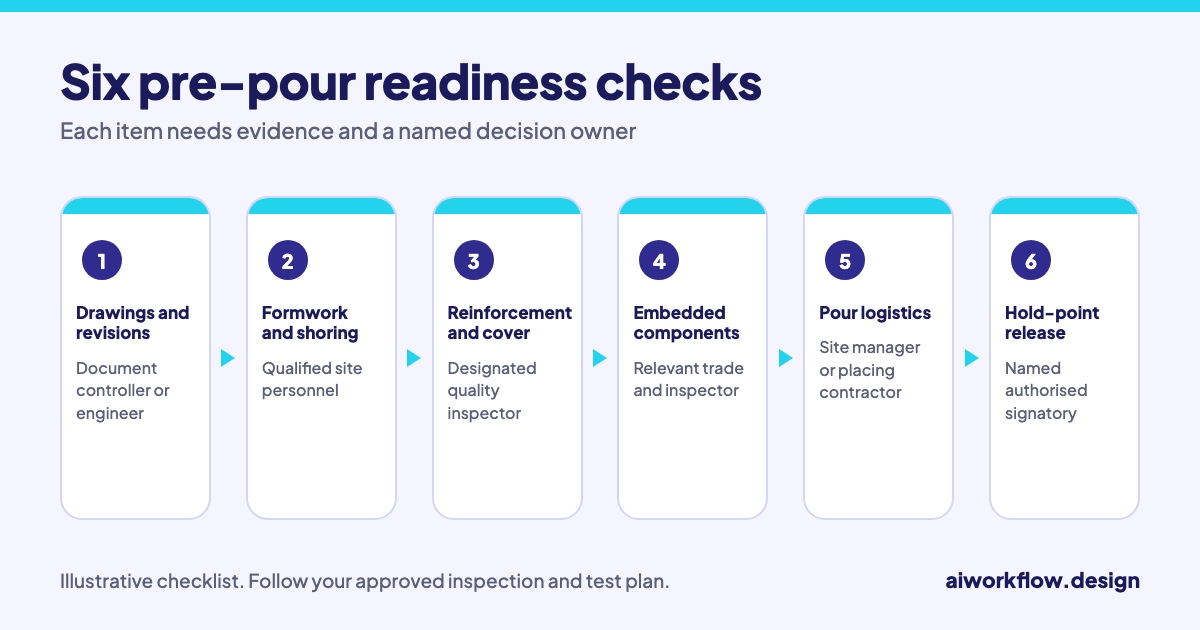
| Readiness item | Evidence to verify | Decision owner |
|---|---|---|
| Drawings and revisions | Current structural and coordinated service drawings | Document controller / engineer as specified |
| Formwork and shoring | Inspection of dimensions, bracing and support | Qualified formwork/site personnel |
| Reinforcement and cover | Approved inspection record and relevant test documents | Designated quality / special inspector |
| Embedded components | Sleeves, anchors, boxouts and service coordination | Relevant trade and inspector |
| Pour logistics | Access, pump, crew, concrete supply, weather contingency | Site manager / placing contractor |
| Hold-point release | Explicit approval under the inspection and test plan | Named authorised signatory |
The matrix is a coordination tool. It should link to the formal inspection forms, not attempt to replace them with a phone transcript or a colour-coded project board. If the contract requires a special inspector, the team must schedule that individual before concrete arrival, not substitute a foreman’s verbal assurance.
Work backward from the pour window
Start with the intended placement time and build a short look-ahead. At an early checkpoint, verify that the latest drawings, inspection requests and test certificates exist. At the next checkpoint, confirm that trade work and access are complete enough for inspection. Immediately before placement, review the official hold-point status and document any open nonconformity.
A common failure is releasing concrete delivery based on the statement “the inspector is coming.” Attendance is not a passed inspection. The responsible person needs the actual signed or electronically authorised release where the plan requires one. Where an inspection cannot be completed, revise the delivery booking and notify dependent trades instead of pressuring a worker to declare the area ready.
Weather, safe access, plant condition and concrete mix logistics also matter. A technical release does not automatically settle changing site conditions. The superintendent or other authorised person still decides whether placement can proceed safely.
Five calls that are useful—and five assumptions to avoid
A scheduled call is useful when it resolves an information gap, not when it tries to replace an inspection. The first call might go to the rebar lead: “Is the last bar fixing complete in Zone B? If not, which item remains?” Another might go to the services coordinator about sleeves and penetrations. The inspection coordinator can confirm whether the formal inspection has been booked and which records are expected.
Use calls to gather the following updates: current work status, a specific blocker, the person responsible, expected evidence availability and the next time the plan should be reviewed. Do not use them to declare a form safe, certify reinforcement placement, attest that concrete meets a specification, waive an inspection, or approve the pour. Those conclusions require qualified people working under the applicable procedures.
The distinction matters even if the person answering is experienced. “We finished tying steel” is a useful progress update; “steel is compliant” is a technical judgement that needs the appropriate inspection record.
Suggested monday.com board and escalation rules
One item per pour area can carry subitems for drawing control, formwork, reinforcement, embeds, inspection booking, logistics and formal release. Separate progress notes from an authorised release reference. Use explicit statuses such as Not Started, In Progress, Awaiting Inspection, Hold – Correction Required, and Released per Inspection Record. Only designated team members should be able to change the last status.
With AI Workflow Design’s scheduled project check-in tools, a team could configure calls to gather progress from work-package owners and flag incomplete prerequisites. The company’s published offering describes AI phone check-ins and task updates; that does not establish that the product independently verifies engineering evidence or connects to a jurisdiction’s inspection portal. Those integrations or mappings would need specific confirmation.
A sensible escalation rule is triggered when a worker reports a missing inspection, conflicting revision, damaged support, unsafe access or uncertain release. Escalate immediately to the responsible human lead and keep the pour on hold in the controlled process. A call that goes unanswered is simply unresolved information—not approval and not proof of a defect.
Turn inspection evidence into a reliable handoff
After an inspection, the coordinator should record the date, inspected area, any correction item, the approval reference and the next dependent task. Do not delete an old nonconformity merely because a corrected item has been entered; the audit trail should show the correction and the resulting release.
At the shift handover, use one clear sentence per hold point: “Zone B reinforcement inspection: correction requested, revised detail pending, placement not released.” This is more useful than a generic “amber” flag. When the inspection record arrives, a person with the right authority updates the state and lets procurement or the placing contractor know what can happen next.
A field crew working without a monday.com board may prefer a different status-collection route. The Daily Check-in Agent describes general field check-ins; the formal safety and inspection release stays with qualified site personnel regardless of which tool collects updates.
Frequently asked questions
What should a concrete pre pour inspection checklist include?
It should include the current approved drawings, inspection area, formwork and shoring checks, reinforcement, embeds, required material and test records, inspection bookings, open defects and the authorised hold-point release. The exact scope follows the project inspection and test plan.
Who can release a concrete hold point?
Only the person or role authorised by the contract, inspection plan and applicable rules. An AI caller, generic project manager reminder or unverified verbal update is not a substitute for that approval.
Can a supervisor schedule the concrete trucks before the inspection?
Planning a provisional delivery slot may be commercially necessary, but the site must respect the required hold points before placement. Confirm the supplier’s cancellation terms and avoid treating a booking as evidence of release.
How should missed inspector calls be recorded?
Log the attempt as no response, preserve the planned inspection status, notify the inspection coordinator and use the agreed follow-up method. Do not infer that an inspection passed, failed or took place.
Can monday.com hold all the inspection documents?
A board can organise references, tasks and status, but the authoritative inspection records may need to remain in a controlled quality-management repository. Use permissions and links rather than duplicating uncontrolled technical files.
Next step: protect the pour by making missing information visible
Choose one upcoming concrete zone and map every hold-point owner, due date and required record. Then decide which ordinary progress updates can be collected through scheduled calls and which decisions must stay with qualified personnel. Review AI Workflow Design’s check-in products for a practical discussion of task follow-up alongside monday.com, not in place of formal inspection.
Related reading
- Construction Submittal Approvals: A Follow-Up Matrix for Shop Drawings and Product Data
- Equipment Rental Off-Hire: Avoid Paying for Idle Plant on Site
- Trade Handoff Readiness: A Checklist Before the Next Subcontractor Arrives
- 7 Questions an AI Construction Check-In Should Ask Before a Milestone
- Change Order Check-Ins: Capture Construction Site Facts Without Approving Extra Work
- Explore workflows by industry
- Autoza AI for monday.com