
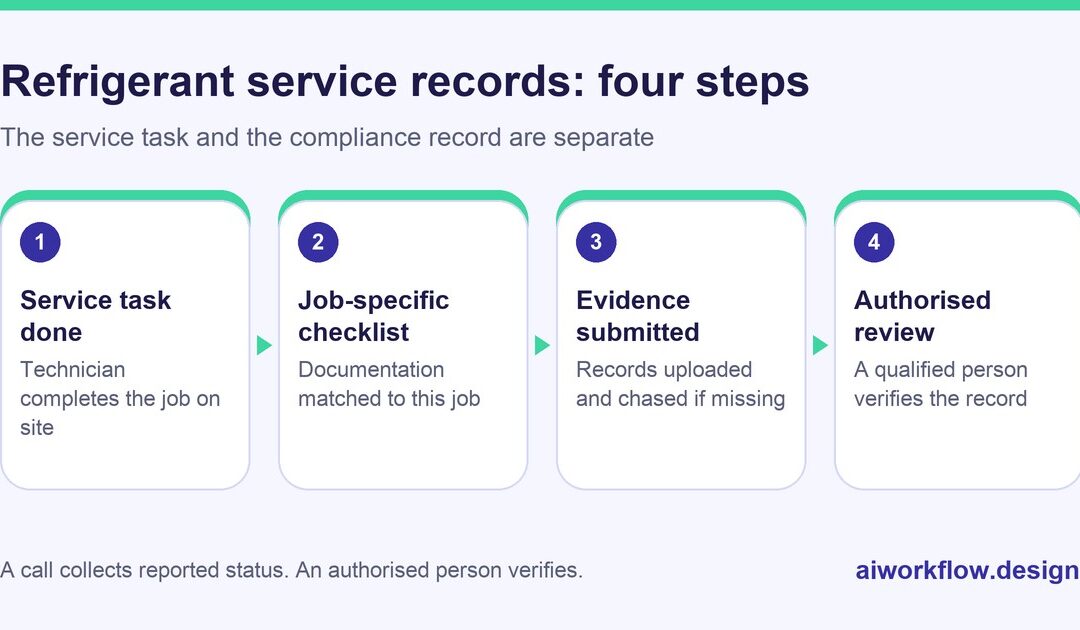
An HVAC refrigerant service record checklist helps dispatchers collect the right paperwork without taking over the technician’s technical judgment. A work order might be marked “fixed” after a unit starts cooling again, while the service record still lacks the refrigerant information, required leak-test documentation or a review trail. Those are different stages of completion.
For US stationary air-conditioning and refrigeration work, the relevant EPA obligations are not identical for every appliance. The equipment, refrigerant, size and activity matter. Build a documented follow-up process that asks for facts and missing evidence, then leaves regulatory interpretation and repair acceptance with qualified people.
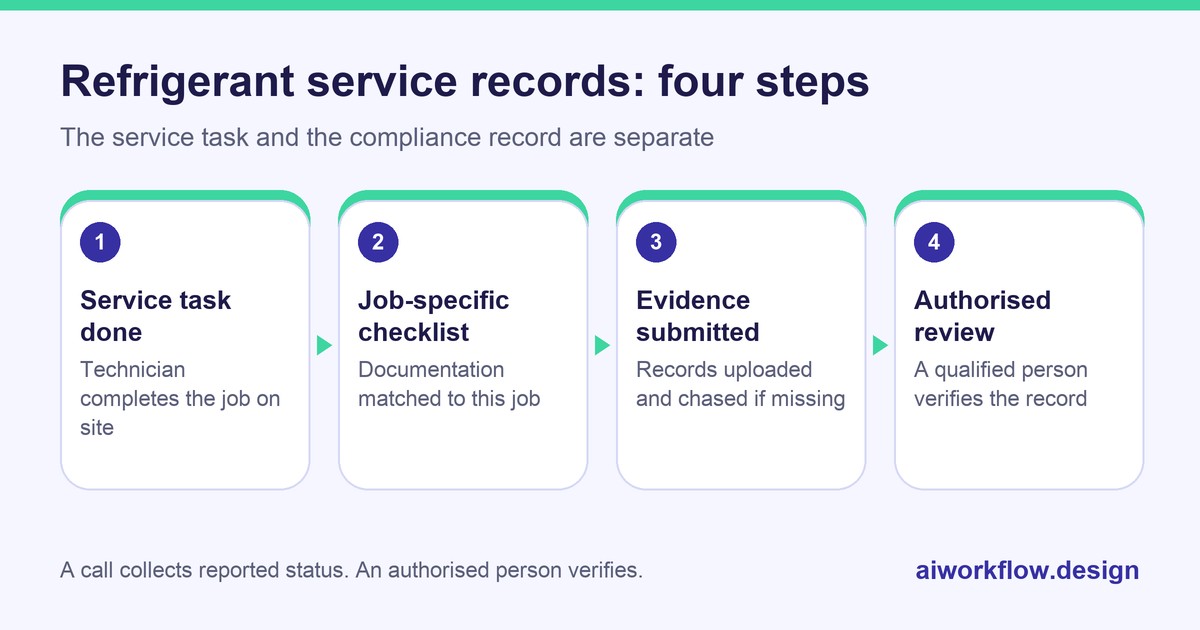
Separate the service task from the compliance record
Create distinct fields for Work reported complete, Service report uploaded, Required records reviewed, Follow-up technical action and Job approved for closure. A technician’s verbal report can update the first field; it should not silently change the remaining ones. The dispatcher should know what record is expected for that particular job, rather than using one universal refrigerant question set.
The US EPA’s recordkeeping overview for stationary refrigeration describes different requirements for technicians, equipment owners and other participants. It includes specific documentation conditions for certain large appliances containing ozone-depleting refrigerants. Do not generalise those conditions to every small split system or every newer refrigerant.
Build a job-specific documentation checklist
A recommended record has Appliance or asset ID, Site, Date, Technician, Work description, Refrigerant type, Quantity added or recovered when relevant, Leak-check or verification-test evidence where applicable, Customer notification, Document link and Reviewer. Other fields may be required by the operator’s own process, local law or contractual warranty terms.
For any measured values, make the source a technician’s signed or controlled service record, not the AI’s paraphrase. If a unit is managed by a facilities client, clarify whether the owner keeps the master register and which documents the service provider must supply. Protect customer building details and equipment information using approved access controls.
Check certification without asking an AI to certify competence
EPA Section 608 technician certification rules require certification for covered service work that could release refrigerants, subject to the rule’s definitions and exemptions. Dispatch should verify the necessary credentials through the employer’s approved process, rather than asking the caller to pronounce a licence valid or invalid based on a verbal statement.
If a record is missing, assign a documentation task to the responsible technician or supervisor and preserve the status “verification outstanding”. An unverified worker credential is not made valid by a completed phone call, and no automated status update should authorise work that needs a competent technician.
Time the follow-up around the work, not just the shift
The first check should occur after a safe work pause, not while someone is handling refrigerant, testing live systems or driving. Ask whether the job remains open and whether required documentation is available. If supporting test results are pending, set a due point aligned to the technical procedure rather than an arbitrary universal deadline.
The EPA’s Section 608 technician questions and answers explains conditional documentation requirements, including certain leak inspections and verification tests. A field-service manager should validate the applicable rule and the client’s contract. Automated calling may remind the owner to provide records, but it must not decide when an appliance has passed a regulated test.
Ask only the questions a status caller can answer safely
A suitable call for an assigned technician asks: (1) Is the work reported complete or is a return visit needed? (2) Has the service record been submitted through the approved system? (3) Are any required test or inspection records awaiting review? (4) Is the equipment owner awaiting a document or notice? (5) Who needs to resolve the remaining blocker and by when? Map responses to the correct asset or task reference.
Do not have the AI extract or invent refrigerant quantities from a vague statement. Where exact measurements are necessary, collect them through a controlled form or technician document. Do not expose customer address details or equipment vulnerabilities in broad team summaries.
Handle incomplete or conflicting evidence openly
Consider a hypothetical commercial plant visit. The technician reports that a leak repair was performed and a follow-up check is scheduled. The dispatcher can mark “repair reported” and set an evidence-chase task. If the customer portal shows the test result is missing, the board remains “verification pending”. A qualified reviewer later checks whether the required documentation and any further technical steps are complete.
If a report contradicts the spoken update, preserve both and escalate. Do not overwrite a test result because an AI summary sounds more confident, and do not issue a warranty or compliance certificate based on a conversational transcript alone.
Make the next audit easier than the last one
Periodically review outstanding service-document tasks by site, equipment type and reason for delay. Missing signatures, an inaccessible customer portal and uncertainty about which refrigerant records apply are different problems. Fix the intake form or the owner assignment rather than simply increasing the number of calls. Managers can track the time between a work report and an approved documentation review, but should avoid turning a fast closure metric into pressure to invent readings or skip technical evidence. A better process makes it easier for certified technicians to file accurate information and easier for the owner to find it later.
Integrate documentation chasing with the existing workflow
Autoza AI for monday.com publicly describes scheduled status calls, summaries and board updates. That can reduce routine document chasing if an administrator configures the right tasks, question set and permissions. If your team uses another tracking system, the Daily Check-in Agent describes similar scheduled calls across other tools.
For evidence-management discipline, see Field Service Photo Evidence. In either workflow, the caller collects a reported status; an authorised person verifies the evidence. Discuss an HVAC documentation follow-up workflow that matches your actual service records.
Explore Autoza AI for monday.com or browse more workflow guides.
Frequently asked questions
What details should an HVAC refrigerant service record include?
Use your organisation’s approved form and applicable law. Common fields include appliance reference, service date, technician identity and certification as required, refrigerant type, work performed, quantities where relevant, test or inspection results, and the location of supporting evidence.
Do all refrigeration jobs have the same EPA recordkeeping requirements?
No. US requirements depend on factors including appliance type, refrigerant and charge size, work performed and the applicable rule. Review current EPA Section 608 guidance and involve a qualified compliance professional for the specific equipment.
Can a dispatcher approve a leak repair from an AI call summary?
No. The dispatcher can chase a missing record, but technical repair verification must follow the applicable procedure and qualified technician or owner review. “Work reported complete” should stay separate from “evidence reviewed”.
What if the technician cannot upload documentation in the field?
Allow an approved secure alternative and record what is outstanding, the responsible person and a deadline. Do not fabricate test values, infer a refrigerant quantity or close a required compliance record based on an incomplete phone response.
How does automated calling help with refrigerant paperwork?
A scheduled check-in can ask whether the work record exists, where it was saved and whether an authorised reviewer is needed. It cannot perform leak tests, certify a technician or replace regulatory submissions.
Related reading
- Field Service Photo Evidence: What to Request After a Job Update Call
- Warranty Service Follow-Up: Record the Right Evidence Before Closing a Job
- Preventive Service Appointments: A Contractor Check-In Workflow
- Second-Visit Jobs: Confirm Parts and Access Before Dispatching a Technician
- Mapping Technician Call Answers to monday.com Job Status Columns