
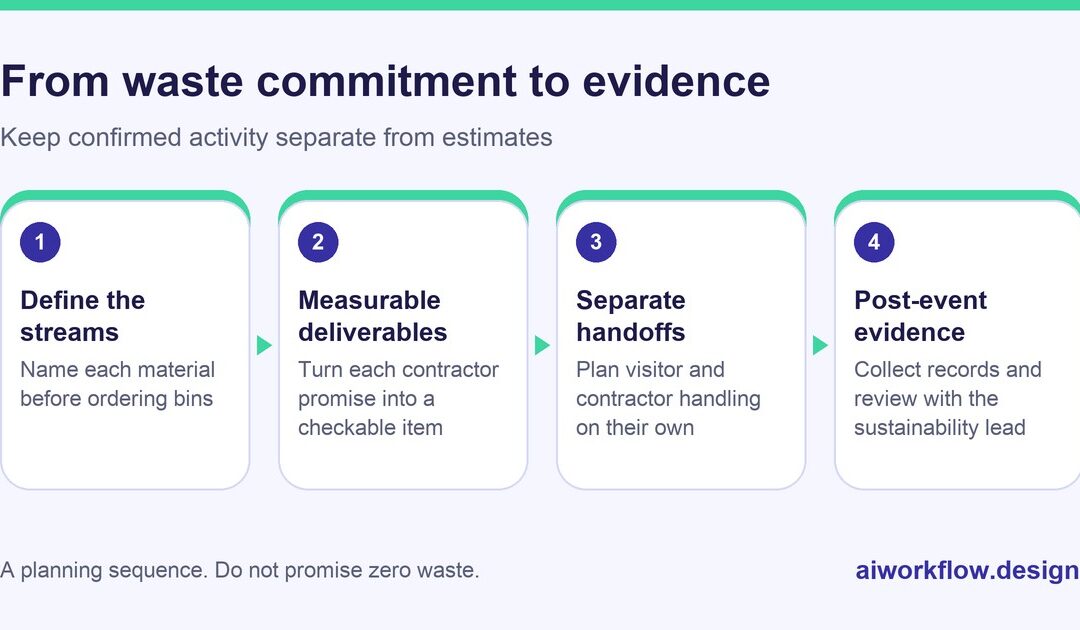
A sustainable event waste management checklist is strongest when it turns contractor promises into verifiable actions. “We provide recycling” is not enough to know whether the venue has separate collection points, whether a waste contractor will accept food-soiled material, or whether the organiser will receive evidence after load-out. Without those details, the event may produce a sustainability claim that cannot be defended.

The practical objective is to reduce waste first, make separation workable during the event and report only what the data supports. That requires a shared schedule between organisers, venues, caterers, exhibitors and contractors.
Define the material streams before ordering bins
List likely materials by source: build and breakdown packaging, signage, carpet, catering surplus, food scraps, mixed recycling, general waste and specialist items such as batteries or electronic equipment. Confirm the actual local collection routes and accepted materials before printing bin graphics. A “compostable” label does not guarantee the local processor accepts a product.
Identify prevention opportunities while contracts are still editable: reusable signage, hired instead of purchased equipment, supplier take-back for packaging and realistic catering quantities. ISO 20121:2024 addresses sustainability management throughout event planning and delivery. It is not a label an event earns by using a green bin, and an organiser should not imply ISO certification without documented status.
Turn each contractor commitment into a measurable deliverable
A useful supplier register includes Waste stream, Source area, Collection contractor, Venue owner, Accepted materials, Containers installed, Planned pickup window, Actual pickup, Evidence type and Reporting reviewer. For temporary exhibitors, assign the organiser’s trade-show operations lead as the person who checks the contractor’s commitments before the load-in deadline.
World Athletics’ sustainable procurement guidance recommends embedding expectations in supplier agreements and obtaining post-event monitoring data. Record the specific information promised: container count, collection dates, weight tickets, destination statement or reuse receipt. Do not ask contractors to manufacture metrics that their system cannot genuinely track.
Design the visitor and contractor handoff separately
Guests need clear, consistent bin labels located where decisions happen. Caterers need instructions for back-of-house food waste, contamination and service changes. Exhibition build crews need a plan for cardboard, pallets, protective film and hire returns. A single recycling station rarely serves all three audiences well.
During a site walk, check whether collection points block accessible paths or emergency routes, whether bins have adequate capacity and whether the servicing contractor can reach them during operating hours. The route itself is a practical deliverable. If containers are relocated, update maps and contractor instructions rather than assuming the old schedule still works.
Plan checkpoints from procurement through post-event review
At procurement, verify the venue’s existing contracts and local processing options. Before build, confirm the supplier’s stream acceptance, container allocation and collection frequency. During operations, sample the condition of collection points and record any contamination or missed service. After load-out, collect the agreed evidence and resolve discrepancies before making a public claim.
The ReFED Low-Waste Events Toolkit includes planner and venue tools for food-waste prevention and post-event summaries. Use that prevention emphasis alongside disposal tracking. The most valuable improvement may be producing less surplus food or reusing more exhibition materials, not merely increasing the number of recycling bins.
Ask questions that separate confirmed activity from estimates
A short contractor follow-up might ask: (1) Have all agreed containers been installed in the approved locations? (2) Which streams can your processing partners actually accept? (3) Were any collections missed or contaminated? (4) What quantity evidence will you supply and by when? (5) Which deviation needs the venue or organiser to decide? Keep site-specific answers with their time, location and supporting document link.
If a contractor says “we probably recycled most of it”, capture it as an unverified estimate. Do not turn it into a percentage or a public environmental claim. A collection receipt may document removal but not the material’s final processing; establish that distinction in the reporting methodology.
Build an honest post-event evidence chain
Consider an illustrative exhibition with cardboard recovery, food-waste collection and rental carpet return. The waste contractor confirms two collections; the venue supplies a separate food-waste ticket; and the exhibition supplier gives a receipt for returned carpet. Those pieces of evidence cover different streams. Before any diversion calculation, an authorised reviewer must check overlap, units, estimated versus measured quantities and the denominator of total waste.
If a stream is missing, publish a limited statement such as the documented activities completed rather than a whole-event diversion rate. Keep a record of assumptions, exclusions and quality issues. This protects the organiser’s credibility and gives procurement better data for the next event.
Decide which performance indicators are defensible
Measure operational reliability separately from environmental outcomes. Contractor confirmation rate, number of missed collections and percentage of promised evidence received show whether suppliers are doing what the agreement says. Waste generation per attendee or reported diversion rates require trustworthy quantities, a clear boundary and consistent calculation rules. If any component is estimated, label it accordingly. Comparing two events without accounting for different attendee numbers, catering styles and venue contracts can mislead the client. Give the sustainability reviewer authority to reject a metric whose evidence is insufficient.
Use scheduled status calls for evidence chasing
Autoza AI for monday.com describes scheduled calls and authorised board updates. In an event waste project, those calls can remind an assigned contractor to report a missed pickup or upload promised evidence. They cannot confirm environmental certification, independently inspect a treatment facility or validate sustainability claims.
Attach an owner and due date to missing evidence, and ask the sustainability lead to review the final report. For other cross-vendor event dependencies, the event weather contingency guide illustrates the value of clear ownership and human review. Book a workflow discussion if routine supplier follow-up is creating avoidable administrative work.
Explore Autoza AI for monday.com or browse more workflow guides.
Frequently asked questions
What belongs in a sustainable event waste management checklist?
Define each waste stream, collection location, responsible contractor, accepted materials, signage, service schedule, contamination checks, post-event evidence and review owner. Include prevention and reuse measures rather than looking only at bin collections.
How should an organiser check a vendor’s recycling claim?
Request the agreed collection and destination evidence, identify the reporting period and reconcile weights or quantities with the event scope. A bin collection or verbal statement alone does not prove material was successfully recycled.
Can a contractor guarantee zero waste?
Avoid an unqualified zero-waste claim. Any such statement needs a clear definition, credible measurement boundary, supporting evidence and an authorised review. Record uncertainties and exclusions openly.
What if a waste contractor misses a collection?
Record the affected location, time and likely operational impact; alert the venue facilities lead and agree a safe corrective action. Avoid blocked access routes or unsafe overflowing bins, and verify the actual collection before closing the item.
Can AI calling calculate event waste diversion rates?
Scheduled calls can collect collection statuses and prompt contractors for evidence. Calculations and public reporting should be based on validated data, a documented methodology and human review, not an AI summary of unsupported claims.
Related reading
- Event Weather Contingency: Task-Owner Check-Ins Before an Outdoor Show
- Multi-City Event Roadshows: A Repeatable Local Vendor Follow-Up Plan
- Venue Access and Load-In: Who Confirms Each Event Logistics Milestone?
- Exhibitor Move-In Deadlines: A Pre-Show Follow-Up Checklist
- Building a Run-of-Show Follow-Up Schedule Across Multiple Vendors