

An event accessibility planning checklist is not a late-stage reminder to order captions. It is a delivery plan that identifies who must make each service work, what proof is needed, and when an unresolved issue must reach a human decision-maker. Captions can be contracted but disconnected from the live audio. A venue may be described as accessible even though the signed visitor route is obstructed during load-in. Both failures are operational, not just administrative.
For conferences, exhibitions and hybrid events, the useful question is: Which accessibility deliverables have actually been tested at the point of use? Set up named owners and evidence requirements before the show schedule fills with last-minute production changes.
Map accessibility across the entire guest journey
Begin with arrival rather than the stage. Document public transport or drop-off information, the entry route, registration height and queue arrangements, circulation between rooms, toilets, accessible seating, service desks and the route out in an emergency. Check whether temporary flooring, cables, merchandise stands or queues will alter the planned paths. A map prepared during venue sales may no longer represent the floor on show day.
Georgetown University’s accessible events checklist emphasises entrances, exits, travel routes, captioning and communication arrangements. Use that breadth to build separate deliverables rather than collapsing all requirements into a single “accessibility” board item. For a hybrid conference, also test the platform’s caption display, recorded-video captions, remote participation and accessible digital instructions.
Give every service a supplier owner and an event owner
A caption provider owns its technical service, but the organiser still owns the handoff. The AV lead must confirm microphone and audio-feed routing; the event producer must distribute timings and speaker names; the accessibility lead must review the planned delivery and exceptions. Use the same two-owner model for interpretation, assistive listening devices, accessible transport and staffed information points.
A recommended register has the columns Deliverable, Event location, Supplier contact, Organiser owner, Due date, Tested status, Evidence link, Open issue, Escalation owner and Approval record. These are suggested monday.com fields, not an out-of-the-box template in Autoza AI. Keep sensitive accommodation communications in a properly controlled channel, not in routine task-owner call transcripts.
Work backwards from opening doors
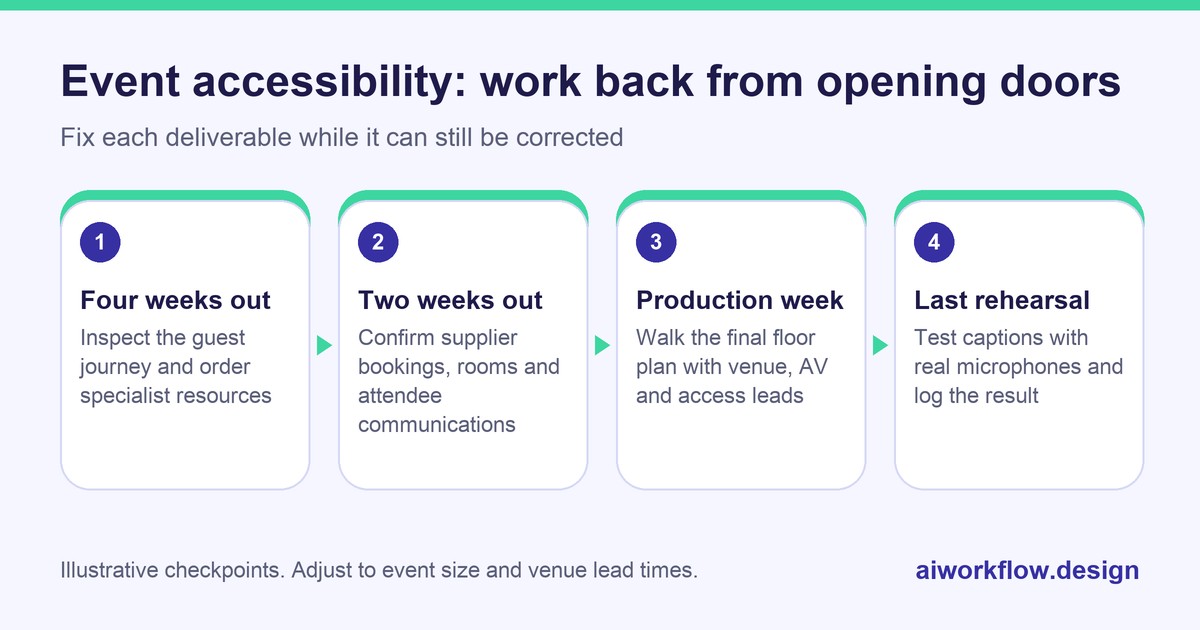
Four weeks out, inspect the guest journey and order specialist resources. Two weeks out, confirm supplier bookings, room allocation and accessible attendee communications. During production week, walk the final floor plan with the venue, AV and accessibility leads. On the last technical rehearsal, test captions with actual speaker microphones and confirm how interpretation, assistive listening and remote access will be monitored.
The exact checkpoints should reflect event size, venue and contractual lead times. A useful rule is to date each deliverable by the moment it can still be corrected—not merely by show opening. If a caption feed fails at rehearsal, a named AV lead should own an immediate troubleshooting action while the organiser checks an approved alternative. Mark the outcome “test failed—human action required”, not “supplier booked”.
Ask five questions that reveal delivery readiness
A short permitted vendor status call can ask: (1) Is the contracted service still confirmed for the named date and location? (2) Which technical prerequisite is still outstanding? (3) When was the last end-to-end test conducted? (4) Who is the onsite lead and backup? (5) What evidence or decision is needed before the organiser can sign off? Answers should be mapped to the specific deliverable and recorded with a timestamp.
Avoid broad prompts such as “Are we accessible?” They invite unsupported assurances. Equally, do not ask suppliers or general staff to report a particular attendee’s diagnosis. The Ontario accessible events guide reinforces that access involves routes, facilities, communications and staff preparation—not only one accommodation vendor.
Build exception rules before the event becomes busy
Separate administrative exceptions from potential barriers. An interpreter awaiting final presentation slides is an owner-and-deadline issue. A blocked accessible entrance or unavailable approved evacuation route needs the venue and safety leads urgently, following the event’s site plan. A supplier failing to answer a routine call remains “not verified”; it is not evidence that the service will fail or succeed.
An escalation matrix should identify the affected guest journey, last reliable evidence, impact if unresolved, latest human decision point and designated approver. Make unresolved high-impact barriers visible at the production meeting and do not allow the board to auto-approve an exception because a call summary contains the word “ready”.
Test the experience, not merely the checklist
For an illustrative two-room business conference, a caption provider may confirm arrival and the AV supplier may confirm an audio output exists. That still does not establish that captions are readable in the overflow room. Run an end-to-end test from the speaker microphone to the audience display, then log the observed result and the person who witnessed it. Walk the accessible route at the time that attendee traffic and temporary equipment are present.
After the event, record failures, incident reports where appropriate, vendor feedback and what should change in future procurement. ISO 20121:2024 provides a wider sustainability-management framework that incorporates social considerations; do not claim certification merely because the checklist is complete.
Where scheduled AI follow-up fits
Autoza AI for monday.com publicly describes scheduled team calls, summaries, retries and board updates. An approved configuration could collect routine supplier confirmations and alert the event team about missing evidence. It should not evaluate legal accessibility compliance, handle emergency direction or adjudicate individual accommodation requests. Define the question set, call permissions and human escalation route before a pilot.
If vendor readiness across an event is a recurring workload, use the existing outdoor-event contingency guide as a companion example of keeping readiness checks separate from live safety decisions. Then discuss a workflow for the specific service owners you need to reach.
Explore Autoza AI for monday.com or browse more workflow guides.
Frequently asked questions
What should an event accessibility planning checklist include?
At minimum, confirm venue access routes, entrances, seating, toilets, stage or presentation access, captioning, assistive listening or interpretation arrangements, staffing, communication channels and a named owner for every service. Keep testing evidence and unresolved exceptions with the project plan.
Is booking a caption provider enough to mark accessibility ready?
No. The organiser should also confirm the service date and room, audio feed, technical test, vocabulary handover, operator contact and backup arrangements. A booking acknowledgement records a commitment, not a successful live rehearsal.
Can an AI caller ask attendees about medical conditions?
Routine project follow-up should not gather diagnoses or personal medical details. Contact approved vendors and internal owners about service readiness. Individual accommodation requests should use an accessible, private process overseen by authorised staff.
Who decides whether an accessible route is safe and usable?
The venue accessibility and safety leads, with appropriate expertise and local requirements, must validate the route. A contractor phone update can flag a barrier or report work completion but cannot certify compliance or replace a physical inspection.
How can monday.com support accessibility planning?
A board can hold each deliverable, owner, test date, supporting evidence, latest reported status and human approval gate. Scheduled follow-up calls can collect updates from assigned people; final verification remains with the organiser.
Related reading
- Event Weather Contingency: Task-Owner Check-Ins Before an Outdoor Show
- Venue Access and Load-In: Who Confirms Each Event Logistics Milestone?
- Exhibitor Move-In Deadlines: A Pre-Show Follow-Up Checklist
- Event Rehearsal Follow-Up: Calls, Task Owners and Exception Rules
- Building a Run-of-Show Follow-Up Schedule Across Multiple Vendors
- Speaker Presentation Collection: A Version-Control and AV Readiness Workflow